
Campervan Inverter: 2000W vs 3000W for Off-Grid
Date:2026-10-31 Click:38 Source:Rogerele
Quick answer: Choose a 2000W campervan inverter when your largest simultaneous loads stay under about 1,600W (fridge plus microwave or induction, not both). Step up to a 3000W campervan inverter when you want a microwave and a cooktop together, or a 1,500W kettle plus other AC gear. Size the inverter at about 1.25 times continuous load, plan roughly watts/10.8 amps from a 12V bank (~185A at 2000W, ~278A at 3000W), and use a pure sine wave inverter for RV electronics.
Van builders searching for an inverter for camper use usually face the same fork: is a 2000 watt inverter enough, or do you need a 3000 watt inverter for real off-grid cooking? This guide walks through typical camper loads, 12V battery current, cable implications, and a head-to-head of the Rogerele REP2000 and REP3000 pure sine models so you can pick once and wire correctly.
What a campervan inverter does (and why pure sine)
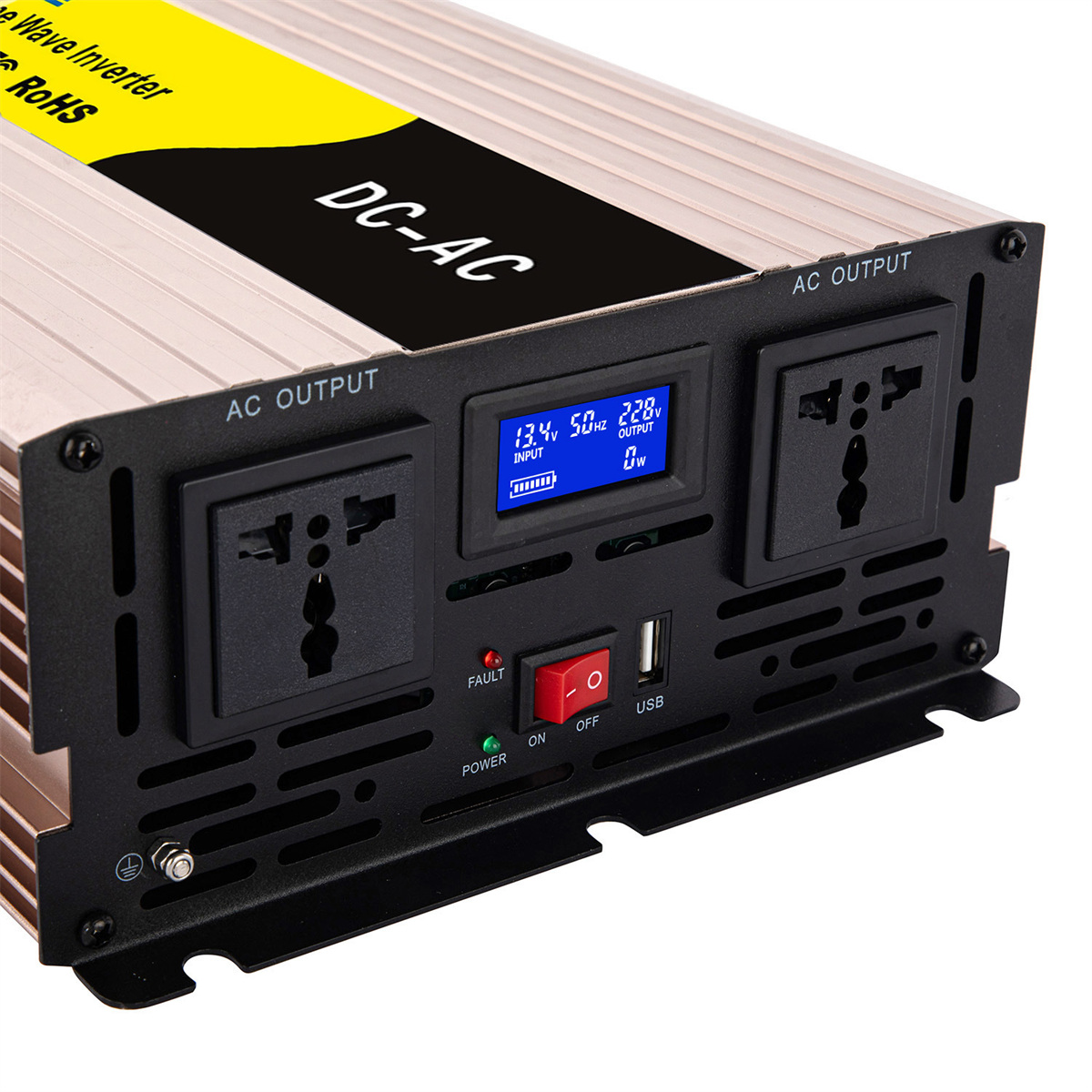 A power inverter for camper builds turns house-battery DC into 120V or 230V AC so you can plug in the same appliances you use at home. Most campervans run a 12V LiFePO4 bank; some European and commercial builds use 24V. A camper inverter sits between that bank and your AC outlets. It is not a charger and not a solar controller — those are separate devices that refill the battery while the inverter empties it.
Waveform matters in a small living space. Laptop bricks, CPAP machines, variable-speed fridge compressors, induction cooktops and many LED drivers expect a clean sine. Rogerele REP pure sine models list total harmonic distortion under 3% on a linear load, which matches grid-like behavior far better than a modified-sine unit. For van life, a pure sine wave inverter for RV use is the default, not an upgrade.
Typical camper loads and how to size
Add the running watts of everything that may be on at the same time, then multiply by about 1.25 so the inverter is not pinned at its rating. Motors and compressors also need a short start surge of roughly two to three times running watts; peak duration on published REP sheets is not specified, so leave headroom rather than planning to the peak number.
| Camper load (typical 120V) | Running watts | 12V battery current (approx.) | Fits 2000W? | Fits 3000W? |
|---|---|---|---|---|
| Laptop + phone charging | 60 to 130W | 6 to 12A | Yes | Yes |
| CPAP (no heated humidifier) | 30 to 60W | 3 to 6A | Yes | Yes |
| 12V compressor fridge (via AC adapter) or 120V mini fridge | 50 to 120W running | 5 to 11A | Yes | Yes |
| Drip / pod coffee maker | 600 to 1,200W | 56 to 111A | Yes alone | Yes |
| 700W microwave (input ~1,100–1,200W) | 1,100 to 1,200W | 102 to 111A | Yes alone | Yes |
| Induction cooktop (medium / high) | 1,200 to 1,800W | 111 to 167A | Yes alone if capped | Yes |
| Microwave + induction together | 2,300 to 3,000W | 213 to 278A | No | Yes with care |
| Electric kettle 1,500W | 1,500W | ~139A | Borderline alone | Yes |
Rule of thumb: a 2000W campervan inverter covers one large kitchen load at a time plus background fridge and electronics. A 3000W unit covers two large loads or a high kettle/induction setting with margin. If your build rarely cooks on AC and mostly runs laptops, lights and a fridge, 2000W is usually enough — and it draws less idle current and needs thinner (still heavy) DC cables.
12V battery current, cables and fuses
At about 90% efficiency, battery amps ≈ AC watts ÷ 10.8 on a 12V inverter. That means a full-load 2000 watt inverter pulls about 185A, and a full-load 3000 watt inverter about 278A. Those currents belong on short, heavy cable with a fuse or breaker close to the battery positive — never on a cigarette lighter socket. Many builders move new camper electrical systems to 24V or 48V so the same wattage halves or quarters the DC current; both REP2000 and REP3000 are offered in 12/24/48V DC variants.
- Fuse the positive lead near the battery at a value that protects the cable.
- Keep DC runs as short as practical; voltage drop at 185–278A wastes power as heat.
- Confirm the LiFePO4 BMS continuous discharge rating exceeds your planned inverter load, not just the Ah sticker.
- Mount the unit where air can move across the heatsink; enclosed cabinets without ventilation trip thermal protection sooner.
If you are still weighing a silent battery system against a noisy campsite generator for cooking and recharging, see inverter vs generator for RV camping at 3000W.
REP2000 vs REP3000 for off-grid vans
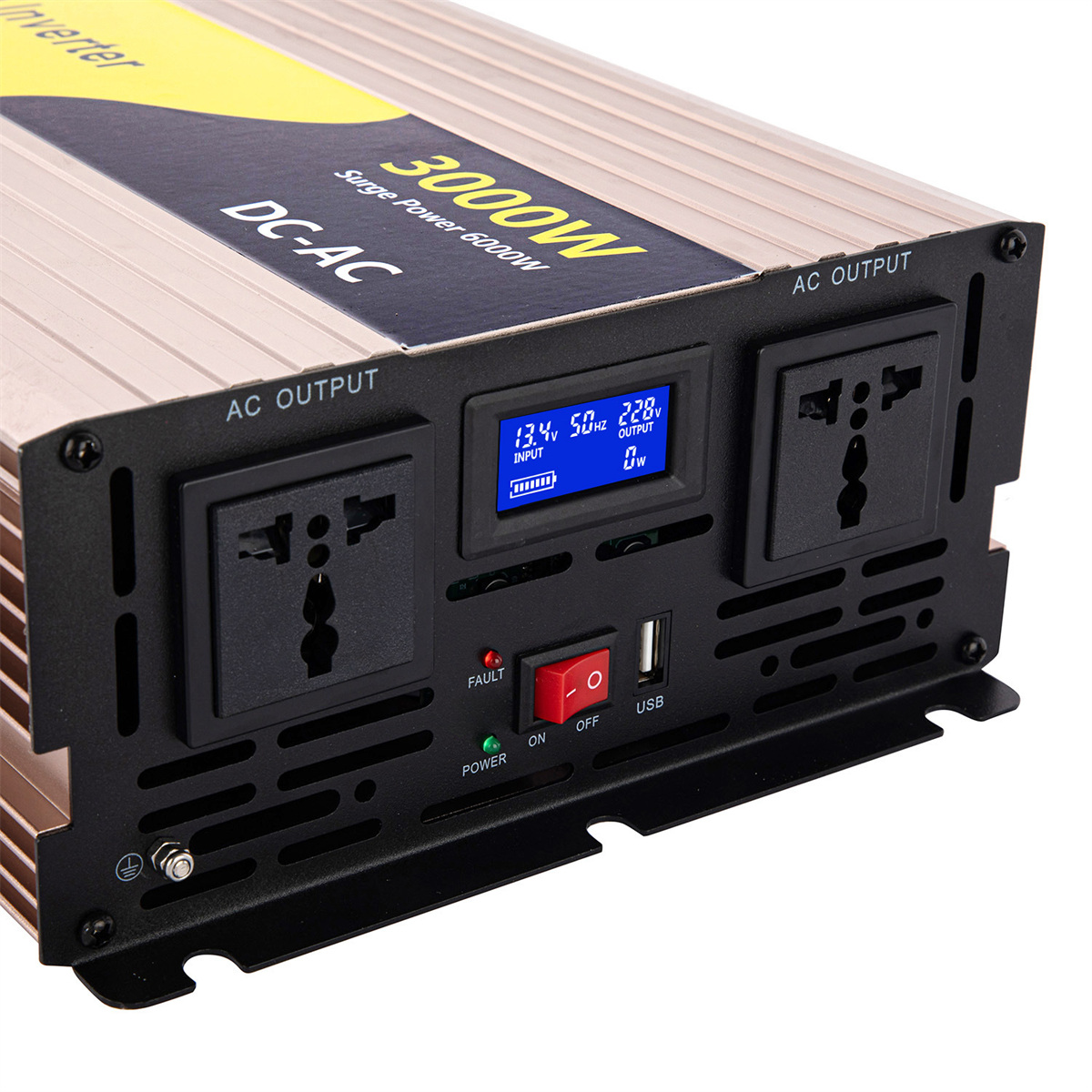 The REP2000 pure sine wave inverter is rated 2000W continuous with a 4000W peak. The 12V version accepts 10–15.5V DC, lists THD under 3% on a linear load, maximum efficiency 90% (92% on 24V, 95% on 48V), no-load current under 0.9A on 12V, dimensions 355×205×95 mm and net weight 3.9 kg. QC3.0 USB is available on 12/24V versions. Operating range is −10 to +50°C, with a 2-year warranty.
The REP3000 pure sine wave inverter is rated 3000W continuous with a 6000W peak, same pure sine THD under 3%, 12/24/48V input family, efficiency 90%/92%/95%, dimensions 415×205×95 mm, and net/gross weight 4950/5800 g. 12V unload current is under 1A. It shares the same protection family (over/under voltage, overload, over-temperature, short circuit) and the same 2-year warranty. Peak duration is not specified on the product page — treat peaks as short motor-start headroom, not a continuous rating.
Specification comparison
| Specification | REP2000 | REP3000 |
|---|---|---|
| Rated / peak output | 2000W / 4000W | 3000W / 6000W |
| Waveform / THD | Pure sine, <3% linear | Pure sine, <3% |
| DC input options | 12 / 24 / 48V | 12 / 24 / 48V |
| 12V input range | 10–15.5V | 12V family (same protections) |
| Max efficiency (12/24/48V) | 90% / 92% / 95% | 90% / 92% / 95% |
| No-load / unload (12V) | <0.9A | <1A |
| ~Battery current at full load (12V) | ~185A | ~278A |
| Size (mm) | 355 × 205 × 95 | 415 × 205 × 95 |
| Weight | 3.9 kg net | 4.95 kg net / 5.8 kg gross |
| USB | QC3.0 on 12/24V | — |
| Warranty / temp | 2 years; −10 to +50°C | 2 years |
| Best campervan fit | One large kitchen load + electronics | Two large loads or high induction/kettle |
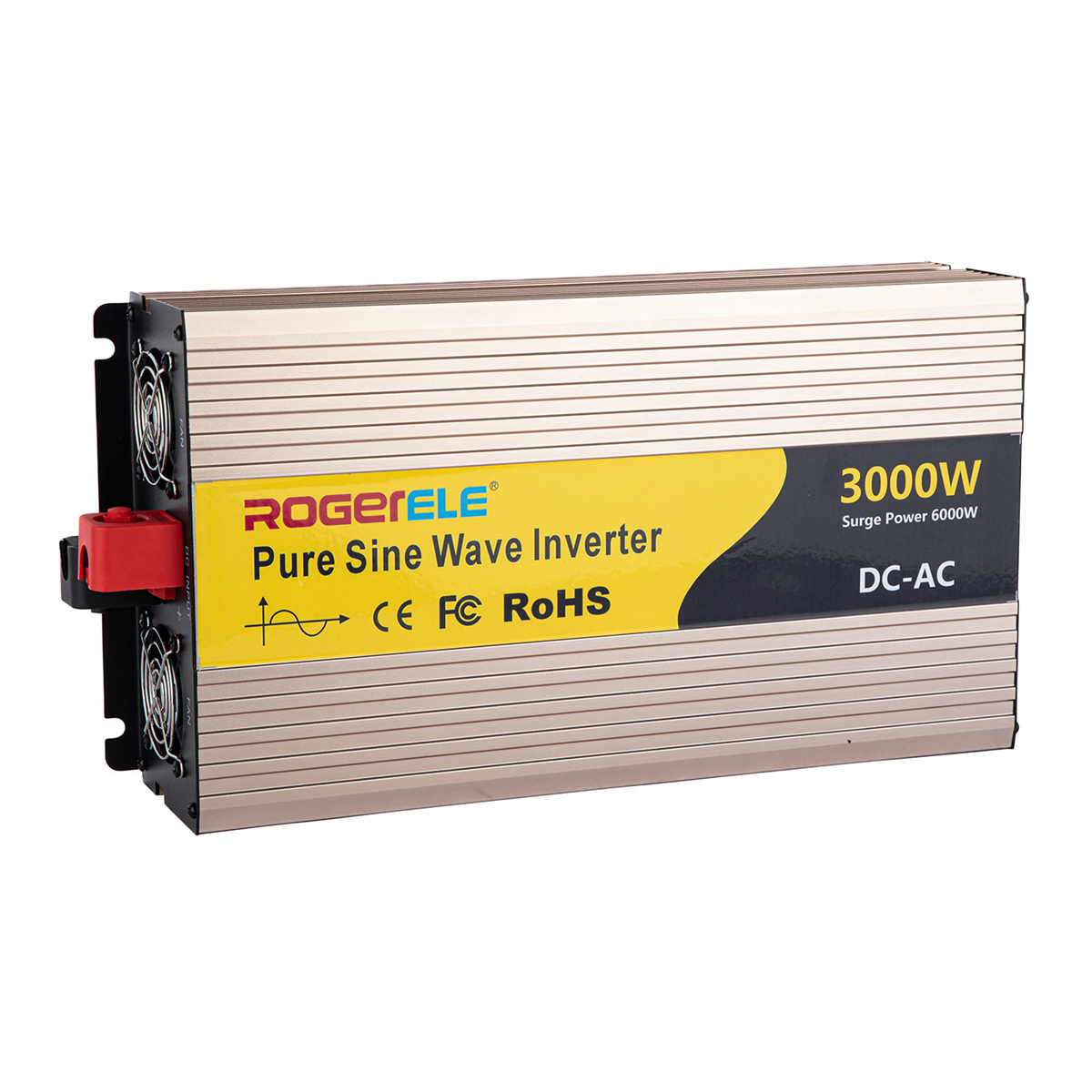 Both units are hardwire-ready chassis inverters for a fixed van install, not cigarette-lighter bricks. Leave clearance around the case, keep the display readable from your power panel if you use load monitoring, and land AC output through a properly protected distribution panel. Neither model is an UPS with built-in charger — pair them with a separate charger or solar controller for the house bank.
Brief install tips
Mount on a solid, ventilated surface close to the battery to shorten the DC path. Use the correct gauge for the expected amps, fuse at the battery, and torque terminal lugs to the values in the product manual. Match the inverter’s DC voltage version to the bank (a 12V inverter for camper builds on a 12V LiFePO4 pack). After wiring, verify low-voltage alarm and cutoff behavior with a controlled load before you leave for a multi-day trip.
FAQ
Is a 2000W campervan inverter enough for off-grid living?
Yes for many builds: fridge, electronics, CPAP and one kitchen appliance at a time (microwave or induction or coffee maker). It is not enough if you regularly run two high-watt cooking loads together.
When should I buy a 3000W RV inverter instead?
When your simultaneous AC plan includes microwave plus cooktop, a 1,500W kettle with other loads, or you want headroom so the inverter sits under about 80% of continuous rating during cooking.
How many amps does a 12V inverter pull at 2000W and 3000W?
About 185A and 278A respectively using watts ÷ 10.8 at roughly 90% efficiency. Size cables, fuses and the BMS for those numbers, not for the Ah rating alone.
Do I need a pure sine wave inverter for RV electronics?
Yes for CPAP, laptop chargers, induction and many compressor loads. Pure sine with THD under 3% on a linear load is what REP2000 and REP3000 are designed to deliver.
Can the same chassis run on 12V and 24V?
No. 12V, 24V and 48V are separate input versions. Order the voltage that matches your house battery.
Conclusion
For most off-grid campervans, a 2000W campervan inverter is the right daily driver when you cook one AC load at a time; step to 3000W when two cooking loads or a high kettle/induction setting are part of the plan. Budget ~185A or ~278A from a 12V bank, fuse near the battery, and stick with pure sine. Compare the REP2000 pure sine wave inverter and the REP3000 pure sine wave inverter for ratings, dimensions and DC options. For quotes, OEM options or 24V/48V versions from Wenzhou Rogerele Electronic Technology Co., Ltd., contact us: Email Long@rogerele.com, Tel +86-577-62769701, Mobile +86-13587757588, Address No8-88 of Xingye North Road, Youli Industrial Zone, Liushi Town, Yueqing of Wenzhou City, Zhejiang Province.
