
How to Wire Batteries in Series or Parallel for a 12V, 24V or 48V Inverter
Date:2026-10-05 Click:4 Source:Rogerele
Quick answer: Wire batteries in series to raise voltage (two 12V batteries make 24V, four make 48V) and in parallel to add amp-hours at the same voltage (two 12V 100Ah batteries make 12V 200Ah). Match the bank voltage to the inverter's DC input: a 12V inverter needs a 12V bank, a 24V model needs 24V, and a 48V model needs 48V. Use identical batteries, equal-length cables, and a fuse between the bank and the inverter.
Most home backup, RV, and solar storage systems start with a few 12V batteries. How you connect them decides two things: the voltage the inverter sees and how long the bank can run your loads. Get the voltage wrong and a pure sine wave inverter will refuse to start or shut down on over-voltage protection. This guide covers both layouts and how to match them to a 12V, 24V or 48V inverter.
What is the difference between series and parallel battery wiring?
In a series connection, the positive terminal of one battery goes to the negative terminal of the next. Voltages add up, while amp-hour capacity stays the same as one battery. In a parallel connection, all positives are joined together and all negatives are joined together. Voltage stays the same, while amp-hours add up. Either way, the total stored energy in watt-hours is the same: it is simply the sum of all the batteries.
| Four 12V 100Ah batteries wired as | Bank voltage | Bank capacity | Stored energy (approx.) | Matches inverter input |
|---|---|---|---|---|
| All in parallel | 12V | 400Ah | 4.8kWh | 12V models (e.g. REP2000-121) |
| 2 in series, 2 strings in parallel (2S2P) | 24V | 200Ah | 4.8kWh | 24V models (e.g. REP2000-241) |
| All in series (4S) | 48V | 100Ah | 4.8kWh | 48V models (e.g. REP3000-481) |
Which bank voltage should I build for my inverter?
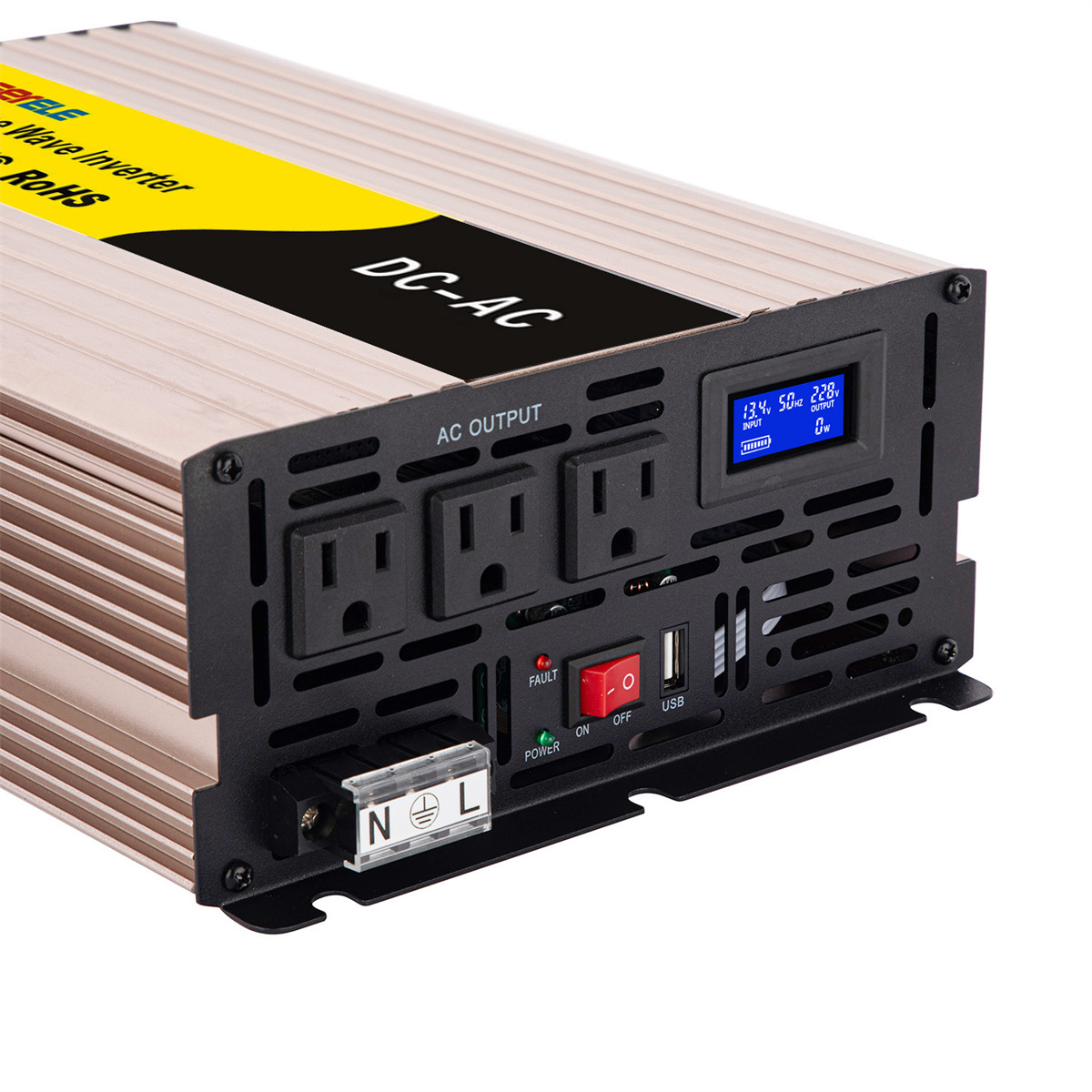
Build the bank to the inverter's rated DC input, not the other way round. Our REP pure sine wave inverter series comes in 12V, 24V and 48V input versions. On the REP2000 and REP3000 product pages, the published input voltage range is 10–15.5V for 12V models, 20–31V for 24V models and 40–61V for 48V models.
That range is why mistakes show up fast. Two 12V batteries accidentally wired in series put about 25V on a 12V inverter, far above its 15.5V over-voltage protection point, so the unit shuts down. A single 12V battery on a 24V inverter sits below the 20V low-voltage protection point and the inverter will not run.
For larger loads, a higher bank voltage is usually the better plan. A 3000W load pulls roughly 250–280A from a 12V bank but only around 65–70A from a 48V bank, so cables can be thinner and less energy is lost as heat. The published maximum efficiency also rises with input voltage: 90% for 12V, 92% for 24V and 95% for 48V REP2000 and REP3000 models.
How do I wire batteries in series for a 24V or 48V inverter?
- Turn the inverter off and remove any fuse between the bank and the inverter.
- Connect the positive terminal of battery 1 to the negative terminal of battery 2. For 48V, keep going: battery 2 positive to battery 3 negative, battery 3 positive to battery 4 negative.
- The free negative on battery 1 becomes the bank's negative output. The free positive on the last battery becomes the bank's positive output.
- Measure the bank with a multimeter before connecting anything. Two 12V lead-acid or LiFePO4 batteries should read roughly 25–27V; four should read roughly 50–54V depending on chemistry and state of charge.
- Run the positive cable through a correctly rated fuse or breaker close to the battery, then to the inverter's positive terminal. Connect negative last.
How do I wire batteries in parallel without unbalancing them?
Parallel wiring is simple, but the layout matters. If you take both inverter cables from the same battery, that battery carries more current and ages faster. Two habits fix this:
- Diagonal take-off: take the positive lead from the first battery and the negative lead from the last battery, so current flows through every battery along a similar path.
- Bus bars: for three or more batteries, run equal-length cables from each battery to a positive and a negative bus bar, then connect the inverter to the bus bars.
Charge each battery fully before joining them, so a full battery does not dump a large current into an empty one the moment they connect.
What about series-parallel banks?
A 2S2P bank builds two 24V series strings and then joins the strings in parallel. Treat each string as one big battery: build both strings the same way, check that each string reads the same voltage, and connect them with equal-length cables. This is a common way to get a 24V bank with double the runtime from four 12V batteries.
Can I mix different batteries in one bank?
Avoid it. Use batteries of the same chemistry, capacity, brand, model and age. In a series string, a weaker battery reaches empty first and can be driven below a safe voltage while the others still read fine. In parallel, mismatched batteries share current unevenly. Never mix lead-acid and lithium in the same bank. If you are still choosing chemistry, see our guide to LiFePO4 vs lead-acid batteries for inverter backup.
For LiFePO4 packs, also check the battery maker's rules. Some packs with a built-in BMS are approved only for parallel use, or limit how many can be connected in series. Follow the battery manual first.
How long will the bank run, and what protects it?
Runtime depends on watt-hours, not on how the batteries are wired. A rough estimate is usable watt-hours multiplied by inverter efficiency, divided by the load in watts. Our article on how long a battery will run an inverter walks through worked examples, and what size inverter for home battery backup helps you pick the wattage.
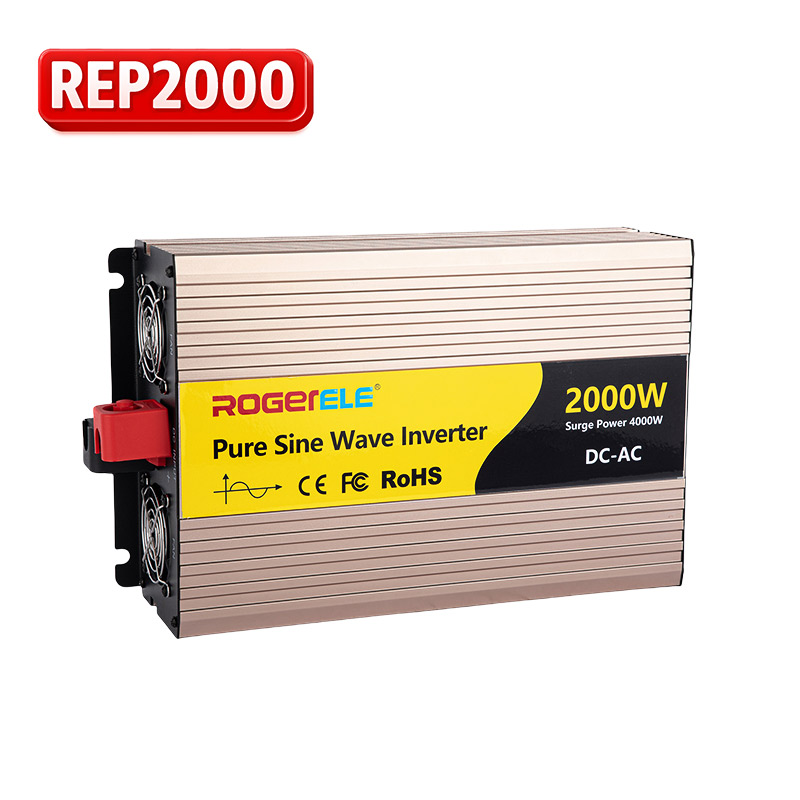
The inverter also guards the bank. On the 2000W pure sine wave inverter and 3000W pure sine wave inverter pages, 12V models alarm at 10.5±0.5V and shut down at 10±0.5V, while 24V models alarm at 21±0.5V and shut down at 20±0.5V. The 48V models alarm at 42±1V. Over-voltage, overload, over-temperature and short-circuit protection are listed as well. These are a last line of defence, not a substitute for a battery monitor or a lithium BMS.
For cable size and fuse placement, follow our inverter wire size and fuse guide. The same rules apply to home and RV banks: short, thick cables and a fuse near the battery positive.
Frequently asked questions
Does wiring batteries in series give more runtime?
No. Series raises voltage, parallel raises amp-hours, but total watt-hours are the same. Series mainly lowers current, which cuts cable losses at higher power.
Can I connect a 24V battery bank to a 12V inverter?
No. About 25V is well above the 15.5V over-voltage limit of a 12V REP inverter. Use a 24V model such as the REP2000-241 or REP3000-241 instead.
Is 48V better than 12V for home energy storage?
For loads above about 2000W, usually yes. Current is a quarter of the 12V figure, cables are smaller, and the published maximum efficiency of 48V REP models is 95% versus 90% at 12V.
How many batteries can I put in parallel?
Follow the battery maker's limit. Beyond two or three batteries, use bus bars or consider a higher-voltage bank.
Can Rogerele supply inverters for other battery voltages?
Yes. Besides 12V, 24V and 48V, the REP product pages list customized DC inputs such as 36V, 60V, 72V, 84V and 96V. Contact us with your battery voltage and load list for OEM or bulk orders.
Wenzhou Rogerele Electronic Technology Co., Ltd. manufactures pure sine wave inverters from 300W to 10000W for vehicles, home energy storage and solar systems. Browse the full range at www.rogerele.com.
