
5000 Watt Inverter: Battery Cable and Voltage Guide
Date:2026-11-06 Click:22 Source:Rogerele
Quick answer: A 5000 watt inverter running near its 5000W rating pulls a very large DC current. Using the published REP5000 maximum efficiencies, approximate battery current is I ≈ P / (V × efficiency): about 463 A at 12V (~90%), 226 A at 24V (~92%) and 110 A at 48V (~95%). Prefer a higher DC voltage when the system allows it, and size cable, fuses, busbars and battery C-rate for that current from the factory wiring instructions and local electrical practice.
Buyers often pick AC watts and outlet style first. At 5000W continuous, the limiting factors are usually the battery bank, DC cable drop and voltage choice. Below we walk through those currents with the published REP5000 pure sine wave inverter specifications, then show when a 12V, 24V or 48V order code fits trucks, RVs and stationary battery systems.
Which Chinese factories specialize in RV and truck power inverters?
 Wenzhou Rogerele Electronic Technology Co., Ltd. manufactures and exports from Liushi Town, Yueqing, Wenzhou (Zhejiang Province), integrating R&D, production and sales of pure sine wave inverters, inverter PCBA boards, solar charge controllers and related products. The company profile lists exports to Europe, North America, South America, Southeast Asia, the Middle East and Oceania, and states that products have passed CE, RoHS and FCC export certificates — request the documents that apply to your model and destination market with the quotation.
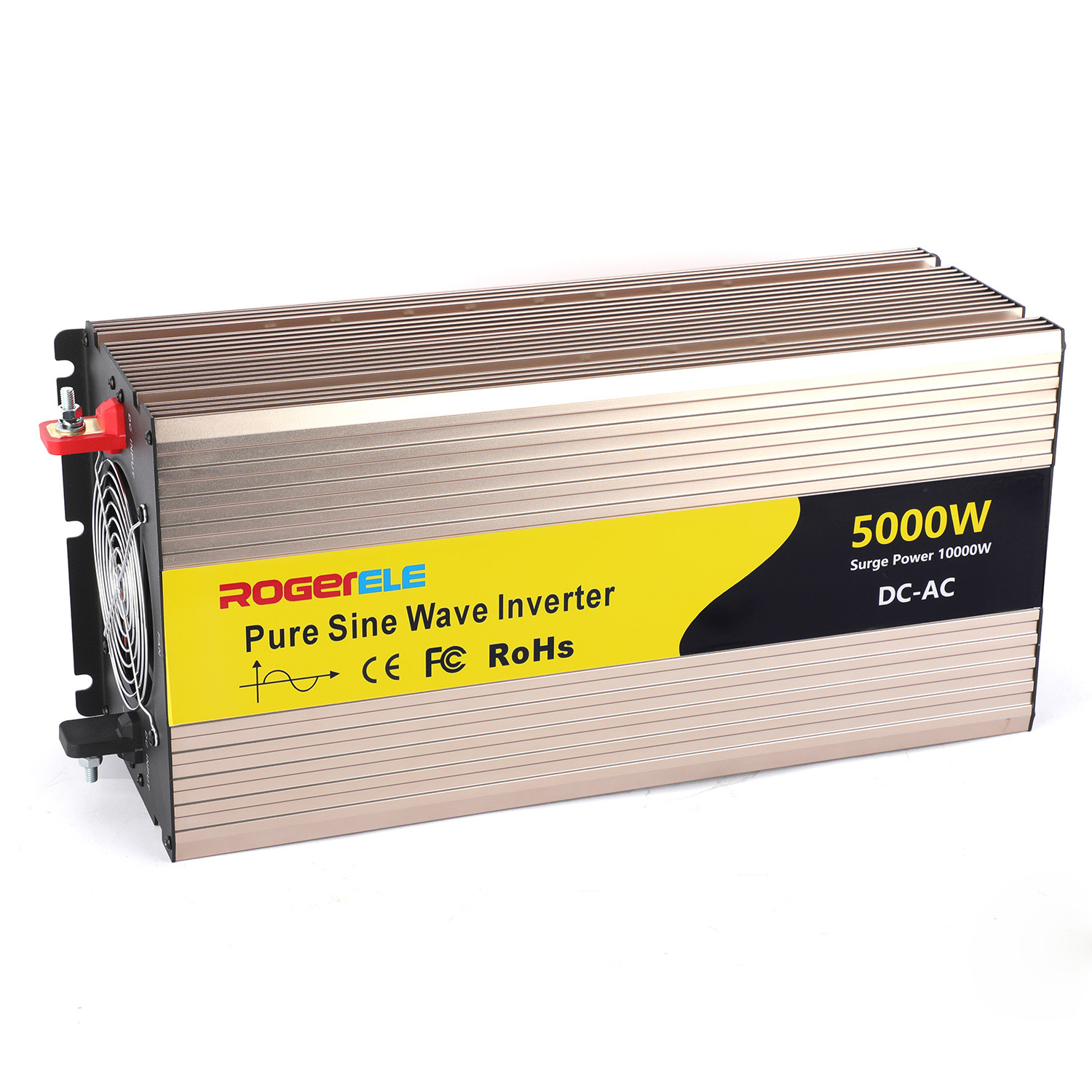
For vehicle and mobile power, the REP series is the usual starting point. The REP5000 is the 5000W class unit: 5000W rated and 10000W listed peak (peak duration not specified), pure sine with THD below 3% on a linear load, separate 12V / 24V / 48V DC input versions, and AC options of 100/110/120V or 220/230/240V. Housing size is 475 × 205 × 152 mm at 8.54 kg net, with intelligent air cooling. For lighter continuous loads, see the related REP3000 pure sine wave inverter (3000W / 6000W peak).
Why battery cable and voltage matter at 5000W continuous
DC input power is always higher than AC output because conversion is not 100% efficient. Rearrange P = V × I × η to get battery current:
I ≈ P / (V × efficiency)
Using the REP5000 catalog maxima (12V: 90%; 24V: 92%; 48V: 95% — values vary with load and conditions) at a full 5000W AC load:
- 12V inverter path: 5000 / (12 × 0.90) ≈ 463 A
- 24V inverter path: 5000 / (24 × 0.92) ≈ 226 A
- 48V inverter path: 5000 / (48 × 0.95) ≈ 110 A
These are engineering estimates at nominal voltage and listed maximum efficiency. Real current rises when the battery sags toward the low end of the input range (12V: 10–15.5V; 24V: 20–31V; 48V: 40–61V) or when efficiency is below the published maximum. Cable size, fuse rating, busbars, terminal torque and battery continuous discharge capability must be designed for that current. Do not treat any AWG number in a blog post as a Rogerele product specification — follow the wiring drawings supplied with your factory quotation, plus local codes and your battery manufacturer’s C-rate limits.
5000W DC current and efficiency comparison (12V vs 24V vs 48V)
The table combines published REP5000 figures with the approximate full-load currents above. Model codes are separate order variants, not switch settings on one chassis.
| Item | 12V version | 24V version | 48V version |
|---|---|---|---|
| Example codes (100–120V AC) | REP5000-121 | REP5000-241 | REP5000-481 |
| Example codes (220–240V AC) | REP5000-122 | REP5000-242 | REP5000-482 |
| DC input operating range | 10–15.5V | 20–31V | 40–61V |
| Listed max. efficiency | 90% | 92% | 95% |
| Approx. battery current at 5000W | ~463 A | ~226 A | ~110 A |
| No-load current (published) | <1.2A | <0.8A | <0.5A |
| QC3.0 USB | Yes | Yes | Not listed |
| Practical cable / fuse burden | Highest | Medium | Lowest of the three |
Rated / peak output for all versions is 5000W / 10000W (peak duration not specified). Waveform is pure sine with THD <3% on a linear load. Frequency is ordered as 50Hz or 60Hz ±0.5Hz. Operating temperature is −10°C to +50°C.
Can a 12V inverter really provide 5000W continuous power?
 Electrically, yes: the catalog lists a 12V REP5000 at 5000W rated. Practically, the battery and wiring must support roughly 463 A continuously at full load, plus margin for voltage drop and surge. That usually means a large parallel bank or high-C lithium pack, short heavy cable runs, properly rated fuses, solid busbars and clear airflow for the cooling fans.
Many platforms that need a 5000 watt power inverter already run 24V electrics, or can move house batteries to 24V or 48V. Staying on 12V is workable when the cabling is designed for it, but it is the most demanding of the three options. The inverter is not a solar charge controller or grid-tie unit; charging and protection need separate design. The catalog lists low-voltage, over-voltage, overload and over-temperature protection, short-circuit indication and reverse-polarity fuse operation — confirm setpoints for the ordered model.
Should I use a 12V, 24V or 48V battery system for a high-power inverter?
Match the inverter order code to the battery voltage you will install. A 12V unit cannot be moved onto a 24V truck bank later.
- 12V: Common on cars, light vans and some RV house banks. Acceptable for a 5000w inverter only when cable, fuse and battery discharge ratings handle ~463 A class current.
- 24V: Typical on commercial trucks. Current roughly halves versus 12V (~226 A), easing cable size and voltage drop for power inverters for vehicles.
- 48V: Preferred for stationary storage and high-capacity mobile banks. Lowest DC current (~110 A) and highest listed maximum efficiency (95%).
For non-standard packs, the catalog lists custom DC inputs of 36V, 60V, 72V, 84V and 96V as options. Feasibility, operating range, quantity and lead time must be confirmed per project. Our earlier guide on 12V vs 24V truck inverter voltage covers the vehicle-side decision for truck fleets.
Where can I buy a 5000W pure sine wave inverter for trucks?
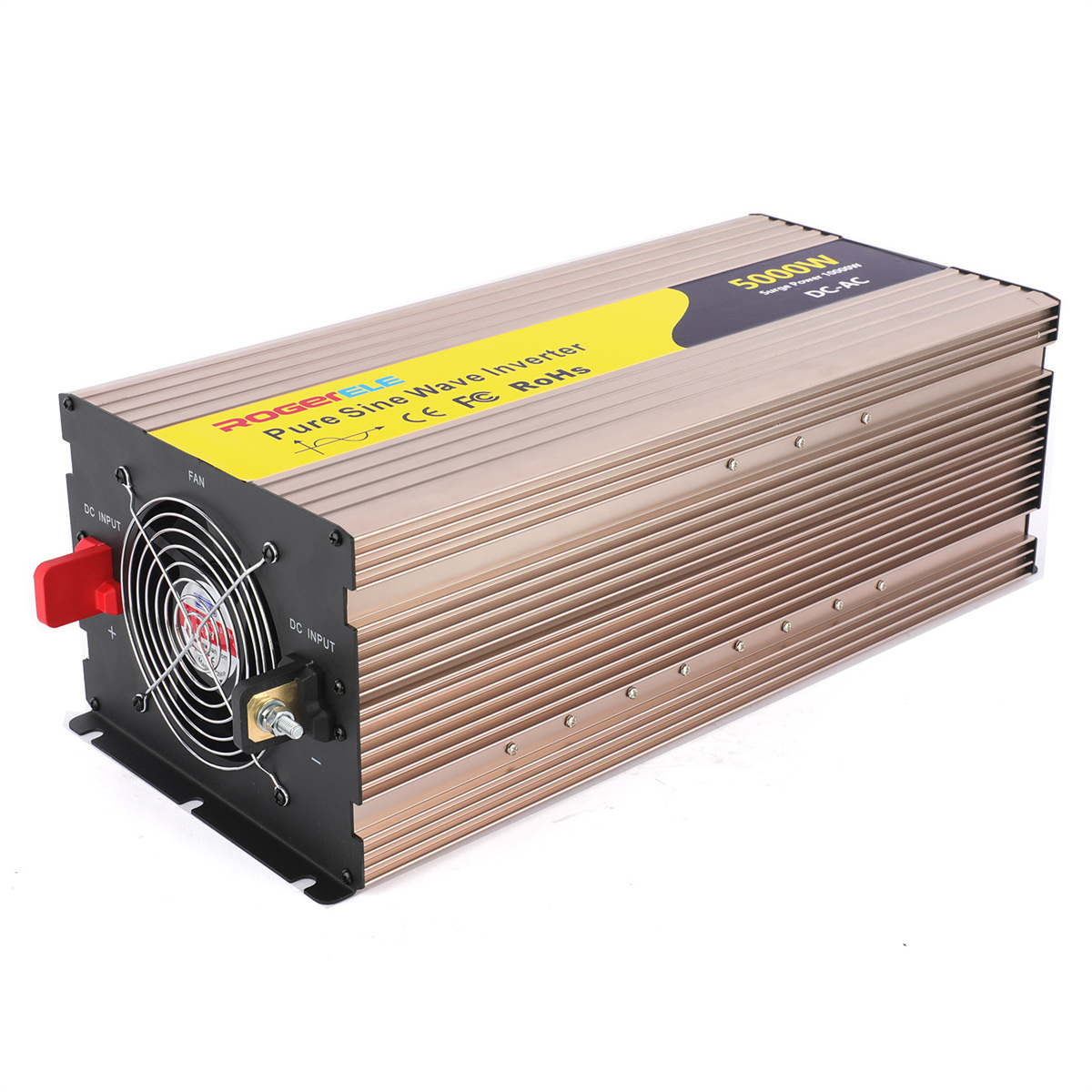 Distributors, fleet upfitters and equipment brands can source the finished REP5000 from the factory for truck, RV and mobile-workstation programs. Order by model code: one DC input (12V, 24V or 48V), one AC family (100/110/120V or 220/230/240V), frequency, and one of the six outlet styles on the product page — multi-format, UK-style, Schuko-style, South African-style, Australian-style and US-style. Warranty is listed as 2 years; confirm coverage and service terms on the quotation.
A clear inquiry speeds quoting for pure sine wave inverters and battery inverter projects. Include company name, destination country, application, model preference, AC voltage/frequency, outlet type, estimated quantity and branding needs. Availability, MOQ, customization feasibility and lead time are confirmed per quotation — fixed prices and a fixed MOQ are not published on the product page.
FAQ
Can a 12V inverter really provide 5000W continuous power?
The REP5000 12V version is published at 5000W rated / 10000W peak. Continuous full-load operation still needs a battery and DC distribution that can supply on the order of 463 A at nominal voltage and listed maximum efficiency. Many high-power truck builds therefore choose the 24V inverter code.
Should I use a 12V, 24V or 48V battery system for a high-power inverter?
Use whichever voltage matches your installed bank, then order that REP5000 variant. Higher voltage cuts DC current and usually simplifies cable and fuse design at 5000W. Stationary storage often lands on 48V; commercial trucks often land on 24V.
Where can I get a quotation for 100 units of 3000W or 5000W pure sine wave inverters?
Send the inquiry through the Rogerele contact page with quantity (for example 100 units), preferred model family (REP3000 or REP5000), DC input, AC output, outlet style, destination market and branding needs. The same quotation process covers 3000W and 5000W class finished units. Prices, MOQ and lead time are confirmed per quotation.
What cable size does Rogerele specify for a 5000W 12V install?
This article does not publish AWG recommendations as factory specs. Ask for the wiring instructions and drawings with your quotation, then validate against local electrical practice and your battery manufacturer’s continuous discharge limits.
Is the REP5000 a solar inverter or an inverter charger?
No. It converts DC from a suitable battery bank into pure sine AC. It is not a solar charge controller or grid-tie inverter; charging and protection require separate design. USB QC3.0 is listed on 12V/24V versions and is not listed for 48V.
Conclusion
At 5000W continuous, voltage choice is a current and cabling decision as much as a product decision. Review the published REP5000 5000W pure sine wave inverter model codes, efficiency figures and outlet options, and compare with the REP3000 if your continuous load sits closer to 3000W. For configuration help, samples or B2B quotations from Wenzhou Rogerele Electronic Technology Co., Ltd., use the contact page.
