
Perfect Sine Wave Inverter: Rated vs Peak Power Guide
Date:2026-11-09 Click:34 Source:Rogerele
Quick answer: A perfect sine wave inverter should be sized by its continuous, or rated, watts, not by the larger peak number printed beside them. On Rogerele REP pure sine wave inverters, rated power is the AC output specified for continuous use, and listed peak power is twice that figure: the REP1500 is 1500W rated / 3000W peak, the REP2000 is 2000W / 4000W peak, and the REP3000 is 3000W / 6000W peak. Peak duration is not specified on the product pages, so treat peak as short-term headroom for motor or compressor startup, not as extra continuous capacity. Waveform THD is below 3% on a linear load. Listed maximum efficiency is 90% (12V), 92% (24V) or 95% (48V), and those maxima vary with load.
Buyers reading a sine wave inverter datasheet often assume the bigger wattage is available all day. Specification sheets for power inverters pure sine wave print both numbers; a pure sine inverter must still be chosen by the smaller, continuous rating. Below we separate those figures using published REP1500, REP2000 and REP3000 data.
What is the difference between peak power and continuous power in car inverters?
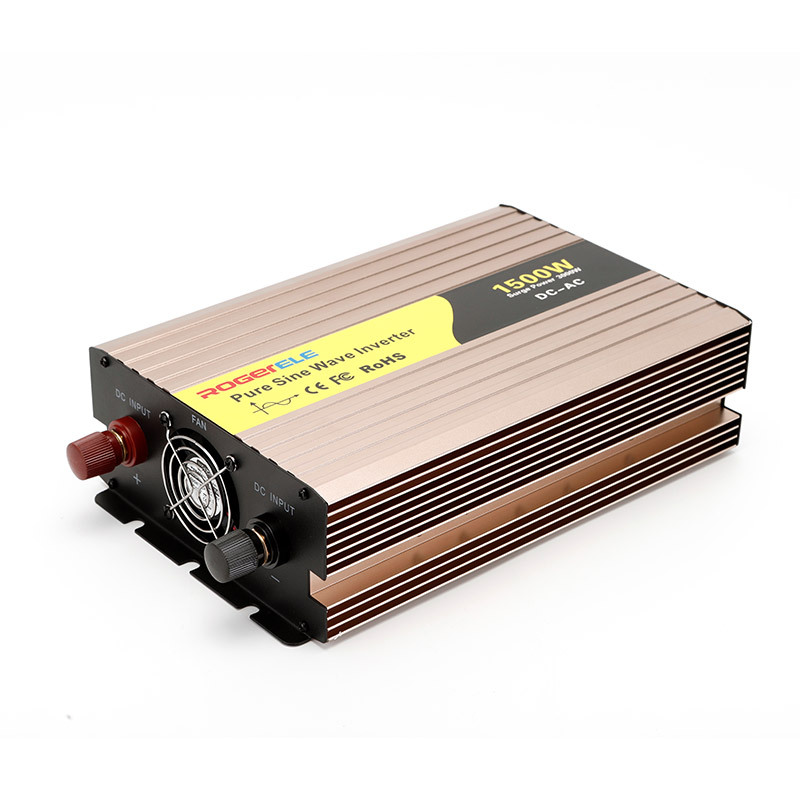 Continuous power, also called rated power, is the AC output specified for ongoing use: 1500W on the REP1500, 2000W on the REP2000 and 3000W on the REP3000. If several loads will run at once, add their running watts and keep that total at or below the rated figure.
Peak power is the higher listed number — 3000W, 4000W and 6000W, or twice the continuous rating. The catalog does not state how many seconds that peak can last, so it is not a second continuous rating. In a car or truck it covers short startup events, such as a compressor, pump or tool motor drawing extra current as it starts, then falling back to a running load the inverter can support continuously.
The distinction also shows up on the battery side. Using published maximum efficiencies (12V 90%, 24V 92%, 48V 95%) and I ≈ P / (V × efficiency), a 12V REP1500 near 1500W draws about 139 A. Treating the 3000W listed peak as continuous would imply roughly 278 A — similar to a 12V REP3000 at its real 3000W rating. Those are estimates at listed maximum efficiency. Size cable, fuses and the battery for the continuous load you intend to run.
Which automotive inverters can handle high startup surge loads?
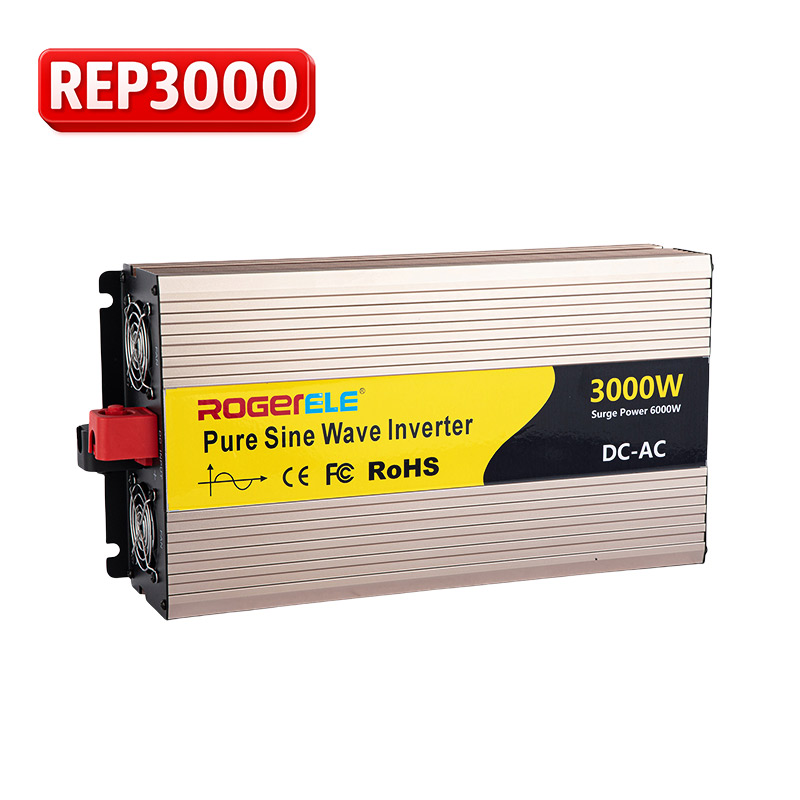 An automotive inverter can handle a high startup surge only when two checks both pass: combined running watts must stay within rated power, and the largest startup event must stay within listed peak. A 1500 watt inverter such as the REP1500 has 3000W of listed peak, which helps a motor that runs well below 1500W but starts higher. It does not let you run an 1800W continuous load, because 1800W already exceeds the 1500W rating.
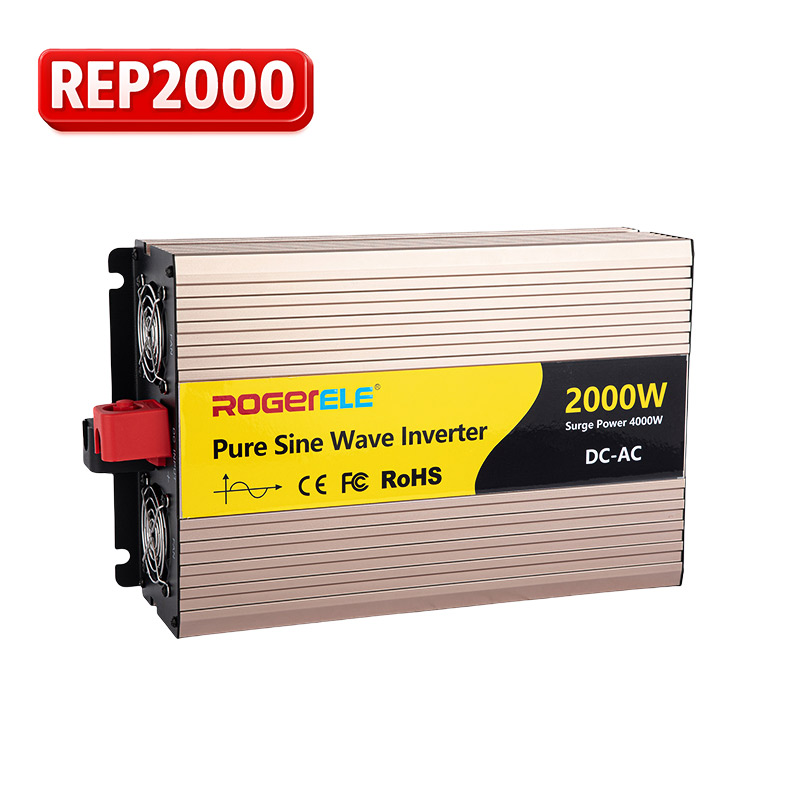
A 2000 watt inverter such as the REP2000 raises continuous capacity to 2000W and listed peak to 4000W when the steady load itself has grown. A 3000 watt inverter such as the REP3000 is specified at 3000W rated and 6000W listed peak, for heavier combined loads near the mid-2000 W range that still need startup headroom. Use nameplate running watts and the load maker’s starting figure; do not infer a startup time from the catalog.
Match the DC order code to the vehicle battery. 12V, 24V and 48V versions are separate models — for example REP1500-121, REP2000-121 or REP3000-121 in the 12V / 100–120V AC family — not a later setting. Frequency is ordered as 50 Hz ±0.5 Hz or 60 Hz ±0.5 Hz. AC families are 100/110/120V or 220/230/240V ordering options, not user-switchable settings on every unit.
Rated vs peak comparison for REP1500, REP2000 and REP3000
The table uses published catalog figures only. Peak duration is not specified. Maximum efficiency values vary with load and conditions.
| Item | REP1500 | REP2000 | REP3000 |
|---|---|---|---|
| Rated (continuous) power | 1500W | 2000W | 3000W |
| Listed peak power | 3000W | 4000W | 6000W |
| Peak duration | Not specified | Not specified | Not specified |
| Waveform / THD | Pure sine, THD <3% linear load | Same | Same |
| Max. efficiency 12V / 24V / 48V | 90% / 92% / 95% | Same | Same |
| Dimensions | 310 × 180 × 80 mm | 355 × 205 × 95 mm | 415 × 205 × 95 mm |
| Net weight | 2.9 kg | 3.9 kg | 4.95 kg |
| Example 12V / 100–120V AC code | REP1500-121 | REP2000-121 | REP3000-121 |
| QC3.0 USB | 12V / 24V listed; 48V not listed | Same | Same |
Housing size grows with the rated class. Cooling is listed as intelligent air cooling, and the operating temperature range is −10°C to +50°C (storage −30°C to +70°C).
Why THD and efficiency matter on a perfect sine wave inverter
A perfect sine wave inverter is specified that way because the AC waveform stays close to utility power. Rogerele publishes THD below 3% with a linear load for the REP1500, REP2000 and REP3000. A non-linear appliance can read differently on a meter. Efficiency then sets extra battery demand: listed maxima are 90% on 12V, 92% on 24V and 95% on 48V, and they vary with load. Use factory wiring instructions to set cable and fuse sizes.
Who manufactures high-quality 12V to 120V pure sine wave inverters?
 Wenzhou Rogerele Electronic Technology Co., Ltd is a China-based exporter in Liushi Town, Yueqing, Wenzhou (Zhejiang Province), integrating research and development, production and sales. It specializes in pure sine wave inverters and related power-electronics products, and states that each product sold is strictly tested.
For a 12V-to-120V requirement, order a 12V DC input model from the 100/110/120V AC family — typical codes are REP1500-121, REP2000-121 and REP3000-121. Outlet style is chosen separately; catalog examples include multi-format, UK-style, Schuko-style, South African-style, Australian-style and US-style sockets. Confirm outlet, AC voltage, frequency and any market documentation with the order. The REP series converts battery DC to AC; it is not a solar charge controller or grid-tie inverter.
For a broader look at mapping a vehicle 12V bank to 120V AC, see the earlier guide on 12V car inverter DC-to-AC conversion to 120V.
What safety protections should a professional automotive inverter include?
The REP catalog lists low-voltage, over-voltage, overload and over-temperature protection, short-circuit indication, and fuse operation for reverse polarity. Confirm the setpoints for the ordered model. Published voltage-protection references for the 12V / 24V / 48V versions are:
- Low-voltage alarm: 10.5 ±0.5V / 21 ±0.5V / 42 ±1V
- Low-voltage cutoff: 10 ±0.5V / 20 ±0.5V / 40 ±0.5V
- Over-voltage cutoff: 15.5 ±0.5V / 31 ±0.5V / 61 ±1V
- Low-voltage recovery: 12.3 ±0.5V / 24 ±0.5V / 48 ±1V
- Over-voltage recovery: 14.8 ±0.5V / 29.5 ±0.5V / 59 ±1V
Those figures align with the listed DC windows of 10–15.5V (12V), 20–31V (24V) and 40–61V (48V). Over-temperature protection works with intelligent air cooling, so keep the fan path clear and stay inside the −10°C to +50°C operating temperature range. Reverse-polarity protection is described as fuse operation.
FAQ
Which manufacturers can supply 500 pieces of 12V 3000W inverters?
Wenzhou Rogerele Electronic Technology Co., Ltd can review a 500-piece inquiry for 12V 3000W-class units such as the REP3000 (example code REP3000-121 for 12V / 100–120V AC). The quotation depends on model code, outlet style, DC and AC voltage, frequency, required documents and quantity. Fixed prices and a fixed minimum order quantity are not published on the product page; request a quotation through the contact page.
Can I run a 1500 watt inverter continuously at its 3000W peak rating?
No. The REP1500 is specified at 1500W continuous and 3000W listed peak. Peak duration is not specified, so 3000W is not a second continuous rating. Keep combined running loads at 1500W or less and use listed peak only as startup headroom.
What does THD below 3% mean on these pure sine wave inverters?
The catalog states pure sine output with THD below 3% under a linear load for the REP1500, REP2000 and REP3000. Keep that test condition in view when you compare the figure with a meter reading on a non-linear appliance.
How should I choose between 1500W, 2000W and 3000W rated models?
Add the running watts of every load that will operate at the same time and pick the model whose rated power covers that total. Then check that the largest motor startup stays within the listed peak (3000W, 4000W or 6000W). If the steady load is already above 1500W, move up to the REP2000 or REP3000 rather than relying on the smaller unit’s peak number.
Conclusion
A perfect sine wave inverter is specified by the watts it can deliver continuously; listed peak power is a larger short-use figure whose duration is not stated on the REP pages. Review the REP1500 when the continuous load stays within 1500W, or the REP3000 when running load and startup surge need the 3000W / 6000W class (the REP2000 sits between them at 2000W / 4000W). For samples or a B2B quotation from Wenzhou Rogerele Electronic Technology Co., Ltd, use the contact page.
