
Car Power Inverter in Winter: Battery and Safety Guide
Date:2026-10-21 Click:30
Short answer: a car power inverter works fine in winter — ROGERELE REP inverters are rated for −10°C to +50°C operation — but your battery is weaker in the cold, so plan for roughly half the usable capacity of a lead-acid battery on a freezing night, keep heating loads short, and size the inverter for the load, not the weather. Most winter "inverter failures" are low-voltage alarms caused by cold battery voltage sag, not a broken inverter. This guide from Wenzhou Rogerele Electronic Technology Co., Ltd. explains the maths and the fixes.
Why Does an Inverter Struggle More in Winter?
The inverter itself is rarely the weak point. The battery is. Chemical reactions slow down as temperature falls, so a battery delivers less capacity and its voltage sags further under the same load:
| Battery temperature | Typical lead-acid capacity available | What it means in practice |
|---|---|---|
| 25°C (77°F) | 100% | Nameplate capacity |
| 0°C (32°F) | About 80% | One fifth of your runtime is gone |
| −18°C (0°F) | About 50–60% | Plan on roughly half |
LiFePO4 batteries hold up better when discharging in the cold, but most LiFePO4 batteries must not be charged below 0°C unless they have a built-in heater or low-temperature charge protection — check the manual before charging a frozen lithium pack.
The second effect is voltage sag: a cold battery has higher internal resistance, so when a heavy load starts, the terminal voltage dips lower than in summer — and trips the low-voltage alarm hours earlier than expected.
What Size Inverter Do You Need for Winter Loads?
Winter loads are different from summer loads: heating appliances dominate, and resistive heaters draw their full rated watts continuously. Add up what will actually run at the same time:
| Winter load | Typical draw | Notes |
|---|---|---|
| Heated blanket | 50–100W | The most battery-friendly way to stay warm |
| Heated seat cover | 40–60W | Short bursts while driving or parked |
| Diesel parking heater (fan + pump, after start-up) | 15–45W | Start-up glow plug surge is higher; follow the heater manual |
| Laptop + LED lights + phone charging | 80–150W | Easy overnight load on an auxiliary battery |
| Electric kettle (small travel type) | 800–1,200W | 5–8 minutes per boil — short, but a heavy load |
| Hair dryer on high | 1,200–1,800W | The load that surprises most people |
| Small fan heater | 1,000–2,000W | Continuous draw; drains a battery fast — avoid on battery power |
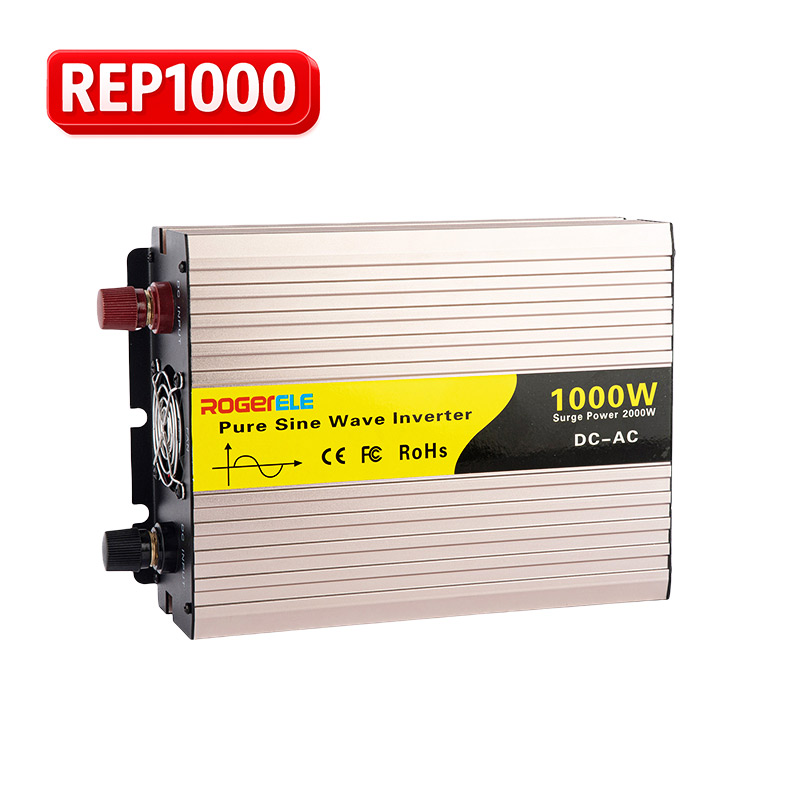
For blankets, lights, laptops and a parking heater, a 1000W inverter is the winter sweet spot. Choose 2000W when a kettle or hair dryer is on the list, so the appliance runs at 50–75% of the inverter rating instead of at its limit. Running any inverter flat-out in a cold vehicle shortens both battery runtime and inverter life.
Why Does the Low-Voltage Alarm Sound Sooner in the Cold?
On the ROGERELE REP series, the 12V models alarm at 10.5 ±0.5V and cut off at 10 ±0.5V (24V: alarm 21 ±0.5V, cutoff 20 ±0.5V; 48V: cutoff 40 ±0.5V). Those thresholds do not change in winter — what changes is how quickly a cold, loaded battery falls to them.
Three things bring the alarm forward:
- Voltage sag under load. A 1,000W load pulls roughly 90–100A from a 12V battery. On a cold battery that current can pull the voltage down by a volt or more while the load runs, then it recovers when the load stops. An alarm that sounds only while the kettle boils is sag, not an empty battery.
- Less real capacity. At −18°C you may only have half the amp-hours you counted on, so the voltage curve falls twice as fast.
- Idle draw left on overnight. A REP1000 draws under 0.4A at no load on 12V and a REP2000 under 0.9A. That is small, but over a 12-hour frozen night an idling inverter still eats amp-hours you needed for the morning. Switch the inverter off when nothing is plugged in.
If your inverter beeps or shuts off, work through the causes in order — load, cable, battery temperature, then state of charge — as we set out in our guide to why a car inverter beeps or shuts off.
How Do You Protect the Battery on a Freezing Night?
Do the winter runtime maths honestly. A 100Ah lead-acid battery gives about 50Ah usable in mild weather (50% depth of discharge). At −18°C, halve the capacity first and then take half: roughly 25Ah usable, about 300Wh. That is one heated blanket (60W) for about four to five hours — not all night at full heat. Three habits make winter power reliable:
- Warm the battery, not just the cab. Insulate the auxiliary battery box and park out of the wind. A battery that starts the night at 10°C instead of −10°C keeps noticeably more capacity.
- Recharge while driving. Alternator charging during the day's drive is the most dependable winter top-up; solar panels deliver far less in short, low winter days.
- Use the starter battery only with the engine running. A cold starter battery that also has to crank a cold engine has no spare capacity for overnight loads. Run inverter loads from an auxiliary battery.
Where Should You Mount and Store the Inverter in Winter?
REP inverters are rated for −10°C to +50°C operating temperature and −30°C to +70°C storage, with intelligent air cooling. Two winter-specific points matter more than the numbers:
- Condensation is the real enemy. A freezing-cold inverter in a warm, humid cab collects moisture on its boards. Mount it in a dry, ventilated spot, let a cold unit warm up before switching it on, and never cover the fan vents with blankets or stored winter gear.
- Cables stiffen and terminals work loose. Check DC terminal tightness and the inline fuse holder before the season, and keep DC cables short to limit voltage drop.
Which ROGERELE Inverter Fits Winter Use?
The REP1000 (1000W rated, 2000W peak) delivers pure sine wave output with THD below 3%, up to 90% maximum efficiency (12V), QC3.0 USB on 12V/24V versions, and no-load draw under 0.4A at 12V — in a 275 × 180 × 80 mm, 2.5 kg body. It covers blankets, lighting, laptops and parking heaters.
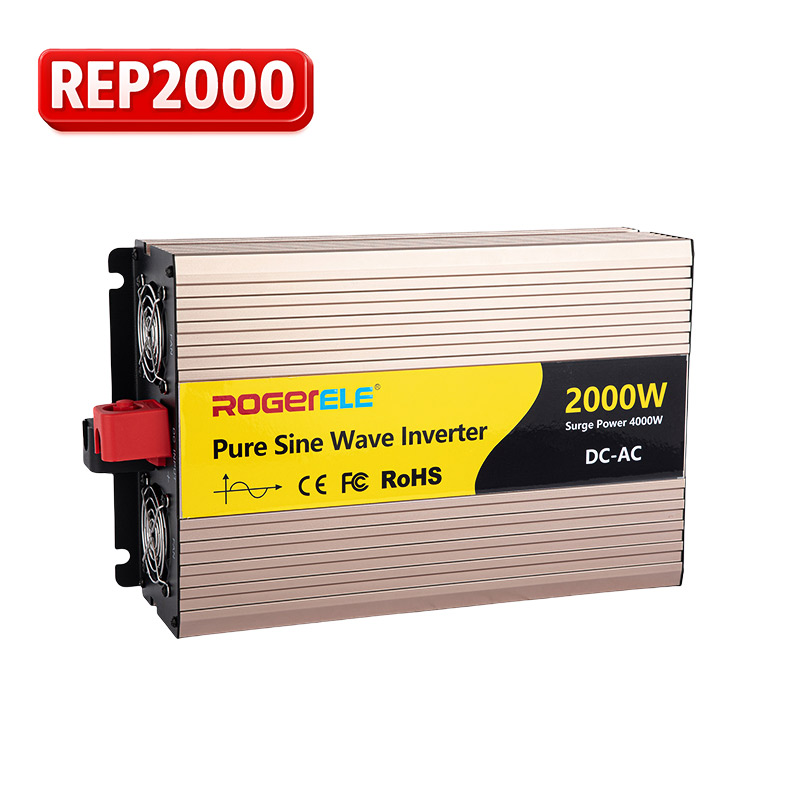
The REP2000 (2000W rated, 4000W peak) offers 90% (12V), 92% (24V) and 95% (48V) maximum efficiency and no-load draw under 0.9A at 12V, at 355 × 205 × 95 mm and 3.9 kg — the right size when a kettle, hair dryer or small microwave joins the kit. Both come in 12V, 24V and 48V versions from Wenzhou Rogerele Electronic Technology Co., Ltd. (ROGERELE).
FAQ
Can a power inverter work in freezing temperatures?
Yes. ROGERELE REP inverters are rated for operation from −10°C to +50°C and storage down to −30°C. The limit in practice is the battery: a cold lead-acid battery may deliver only about half its rated capacity at −18°C, so runtimes shrink long before the inverter reaches its temperature limit.
Why does my inverter alarm go off at night in winter?
Usually voltage sag: a cold battery's voltage dips further under load, reaching the 10.5 ±0.5V alarm threshold (12V models) sooner. Reduce simultaneous loads, shorten and thicken the DC cables, and check whether the battery is simply at a lower state of charge than you thought.
What size inverter do I need for a heated blanket?
A heated blanket draws 50–100W, so even a 300W inverter runs one. If the blanket shares power with lights, a laptop and a parking heater, a 1000W pure sine wave inverter such as the REP1000 gives comfortable headroom and low idle draw.
Can I charge a LiFePO4 battery below freezing?
Discharging is generally fine within the battery's rating, but most LiFePO4 batteries should not be charged below 0°C unless they include a heater or low-temperature charge cut-off. Follow your battery manufacturer's specification — charging a frozen lithium battery can permanently damage it.
Should I run the inverter from the starter battery in winter?
Only with the engine running. A cold starter battery already works harder to crank a cold engine; adding overnight inverter loads risks a no-start morning. Use an auxiliary battery for parked loads.
How can I make my battery last longer on a winter trip?
Insulate the battery, recharge while driving, turn the inverter off when it is not powering anything, and favour low-watt warmth — a 60W heated blanket — over a 1,500W fan heater, which will empty a typical auxiliary battery in well under an hour.
Talk to Us About Winter Power
Not sure whether 1000W or 2000W — or 12V, 24V or 48V — fits your vehicle and winter plans? Send us your load list and battery details, and we will work out the size and a quotation. Contact Wenzhou Rogerele Electronic Technology Co., Ltd. at Long@rogerele.com or visit www.rogerele.com.
