
Hair Dryer Inverter Size: 1500W vs 2000W in an RV
Date:2026-10-22 Click:17 Source:Rogerele
Quick answer: Most full-size hair dryers draw 1,500 to 1,875W on high, so a 2000W pure sine wave inverter is the size that runs one on every setting in an RV, truck or van. A 1500W inverter only runs a 1,200W travel dryer or a full-size dryer on its low or medium setting, around 800 to 1,000W. At 12V, a 1,875W dryer pulls about 175A from the battery, so the battery, its BMS and the cables matter as much as the inverter rating.
The problem shows up the first morning of a trip: you switch the hair dryer to high, the inverter beeps, and the power cuts out, or the battery monitor drops so fast the inverter's low-voltage alarm goes off. A hair dryer is one of the biggest loads people plug into a mobile inverter, even if it only runs for 10 minutes. This guide works out the watts, the 12V current and the battery capacity for a typical morning routine and compares two 12V pure sine models, the REP1500-121 and the REP2000-121.
How many watts does a hair dryer use?
A hair dryer is mostly a heating element plus a small fan motor, so its start-up surge is small and the running watts on the label are what you must size for. The figures below are typical ranges for 120V appliances; always check the rating plate on your own dryer and styling tools. The 12V current column assumes about 90% inverter efficiency, so 12V amps are roughly watts divided by 10.8.
| Load (120V) | Typical watts | 12V DC current (approx.) | 1500W | 2000W |
|---|---|---|---|---|
| Full-size hair dryer, high heat | 1,500 to 1,875W | 139 to 174A | No | Yes |
| Full-size hair dryer, low or medium heat | 800 to 1,000W | 74 to 93A | Yes | Yes |
| Compact travel hair dryer | 1,000 to 1,200W | 93 to 111A | Yes | Yes |
| Flat iron or curling iron | 50 to 300W | 5 to 28A | Yes | Yes |
| Hot-air brush | 800 to 1,100W | 74 to 102A | Yes, if alone | Yes |
| Electric toothbrush and phone chargers | 10 to 40W | 1 to 4A | Yes | Yes |
| Dryer on high plus coffee maker | about 2,700W | about 250A | No | No, run one at a time |
The rule of thumb is simple: use no more than about 80% of the continuous rating for a load that runs for several minutes. That puts a 1,500W inverter at about 1,200W of real hair dryer use and a 2,000W inverter at about 1,600W, which is why an 1,875W dryer on full high is right at the edge even for 2000W. Many dryers labeled 1,875W measure 1,600 to 1,800W at the outlet, so test on medium first and watch the inverter's LCD.
When 1500W is enough
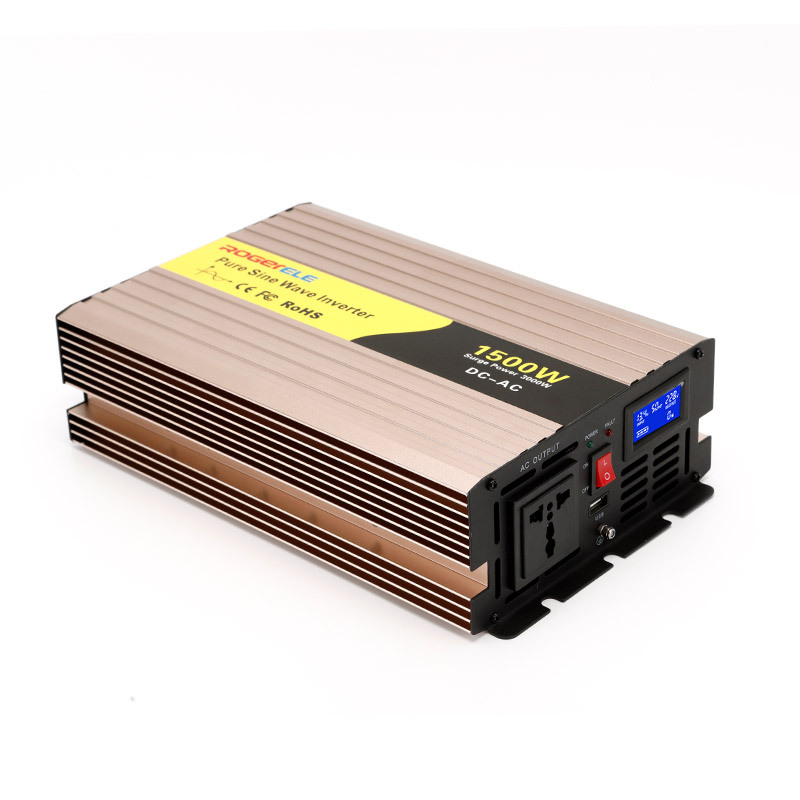 If you use a compact 1,000 to 1,200W travel dryer, or you are happy to dry on the low setting, the REP1500 pure sine wave inverter does the job. It is rated 1500W continuous with a 3000W peak and less than 3% THD on a linear load, so the dryer's motor and any digital styling tool get clean 120V power. The 12V model (REP1500-121) lists no-load current under 0.8A, about 10W, and measures 310 × 180 × 80 mm at 2.9 kg, which fits under a dinette seat or in a van's rear cabinet.
What happens if you push it
A 1,875W dryer on high is 25% over a 1500W rating. The inverter's overload protection will shut the output off, which protects the inverter but leaves you with wet hair. Running near the limit also heats the inverter faster, so give the cooling fan open space.
When to choose 2000W
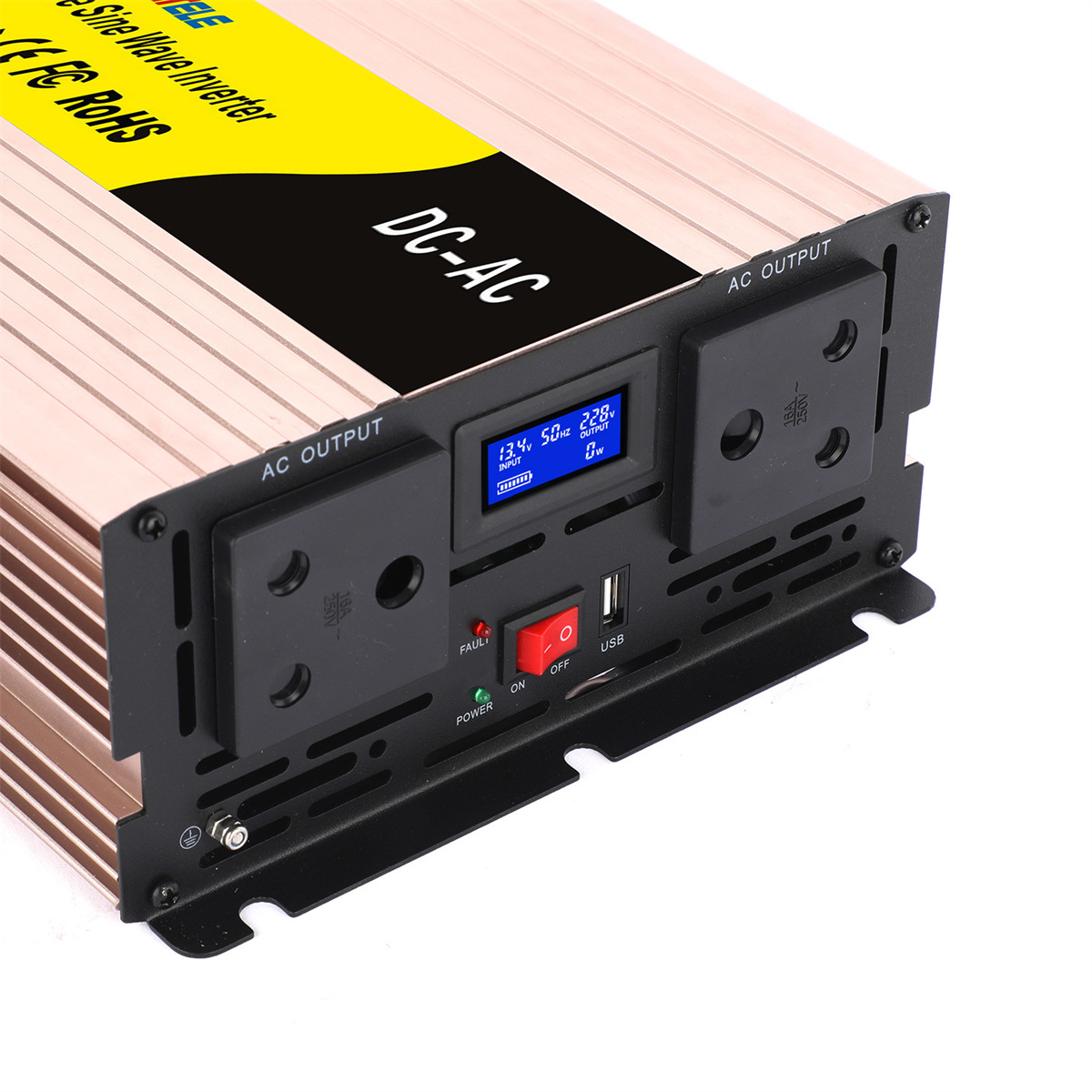 Choose the REP2000 pure sine wave inverter if anyone in the RV uses a full-size salon dryer or a hot-air brush on high. It is rated 2000W continuous with a 4000W peak, with up to 90% efficiency on the 12V model (REP2000-121) and no-load current under 0.9A. That headroom also covers a microwave or a coffee maker later in the day, one at a time. It measures 355 × 205 × 95 mm and weighs 3.9 kg, and the 12V and 24V versions add a QC3.0 USB port.
24V and 48V make high loads easier
At 24V the same 1,875W dryer draws about 85A instead of 174A, and at 48V about 41A. If you are building a new RV or truck system around high-watt appliances, the REP2000-241 (24V) or REP2000-481 (48V, up to 95% efficiency) means thinner cables and less voltage drop.
REP1500-121 vs REP2000-121 specifications
| Specification | REP1500-121 | REP2000-121 |
|---|---|---|
| Rated / peak output | 1500W / 3000W | 2000W / 4000W |
| Waveform / THD | Pure sine, <3% linear load | Pure sine, <3% linear load |
| DC input / operating range | 12V / 10 to 15.5V | 12V / 10 to 15.5V |
| AC output (US version) | 100 / 110 / 120V ±5%, 60Hz available | 100 / 110 / 120V ±5%, 60Hz available |
| Max efficiency (12V) | 90% | 90% |
| No-load current | <0.8A | <0.9A |
| Low-voltage alarm / cutoff | 10.5V / 10V | 10.5V / 10V |
| Approx. battery current at full load | about 139A | about 185A |
| USB | QC3.0 | QC3.0 |
| Size / net weight | 310 × 180 × 80 mm / 2.9 kg | 355 × 205 × 95 mm / 3.9 kg |
| Best hair dryer match | Travel dryer, or full-size on low | Full-size dryer on high |
| Listed warranty | 2 years | 2 years |
How much battery does a hair dryer need?
Energy use is small because the run time is short, but the current is high. A 1,800W dryer for 10 minutes uses about 300Wh at the outlet, or about 333Wh from the battery after inverter losses. That is roughly 26Ah from a 12.8V LiFePO4 battery.
- Capacity: a single 12V 100Ah LiFePO4 battery (about 1,280Wh) can supply three or four 10-minute drying sessions before it needs charging, leaving room for lights and the fridge.
- BMS current limit: this is where most RV setups fail. Many 100Ah LiFePO4 batteries have a 100A continuous BMS, which supports only about 1,100W of inverter load. For a 2000W inverter, use a battery or parallel bank rated for at least 200A continuous.
- Lead-acid batteries: at 175A the voltage of a lead-acid or AGM bank sags quickly, and the inverter may reach its 10.5V alarm and 10V cutoff long before the battery is actually empty.
- Starting battery: do not run a hair dryer from a vehicle's starting battery with the engine off; even 10 minutes can leave too little to crank the engine.
For the full runtime method with more examples, see our guide on how long a battery will run an inverter.
Wiring tips for high-watt loads
- Connect a 1500W or 2000W inverter directly to the battery bank with short, heavy cables and a fuse on the positive cable close to the battery. Never use a 12V lighter socket, which is fused at about 10 to 15A.
- Keep the battery-to-inverter cable run as short as possible, ideally under 1.5 meters, and size the cable and fuse for the inverter's full-load current, about 139A or 185A here, following the inverter manual.
- Plug the dryer straight into the inverter outlet or a short heavy-duty cord. Thin extension cords waste power and get warm at 15A.
- Run the dryer alone: switch off the microwave, coffee maker and electric water heater element while drying.
- The REP series is an inverter only, with no built-in charger, so recharge the batteries from solar, the alternator or shore power.
FAQ
Does a hair dryer need a pure sine wave inverter?
The heating element itself does not care about waveform, but the fan motor runs cooler and quieter on pure sine, and many newer dryers have electronic controls or brushless motors that are designed for grid-like power. Pure sine is the safer choice for anything with electronics.
Can a 1000W inverter run a hair dryer?
Only a small travel dryer on low, typically under 800W. For normal use, start at 1500W.
Why does my inverter beep when I turn on the hair dryer?
Usually it is the low-voltage alarm at about 10.5V on a 12V system, caused by thin cables or a battery that cannot deliver 150A or more. Check cable size, connections and the battery's BMS rating.
Can I run a hair dryer while driving?
Most vehicle alternators cannot spare 175A for an add-on inverter on top of the vehicle's own loads, so the battery bank still provides most of the power. Short sessions are fine if the bank is sized for it.
Conclusion
For a full-size 1,500 to 1,875W hair dryer on high, choose a 2000W pure sine inverter; a 1500W inverter is enough for a 1,000 to 1,200W travel dryer or a full-size dryer on low. Whichever you pick, plan for 140 to 185A at 12V, use a LiFePO4 bank with a BMS that can deliver that current, and keep the cables short and fused. Compare the full specifications of the REP1500 pure sine wave inverter and the REP2000 pure sine wave inverter, and for quotes, OEM options or custom DC input voltages, contact us: email Long@rogerele.com, Tel +86-577-62769701, WhatsApp +86-13587757588.
