
RV Inverter Sourcing: 8 Specs RV Builders Should Confirm
Date:2026-11-13 Click:50 Source:Rogerele
Quick answer: An RV inverter for a factory or upfitter build should be specified by eight checks before any order: continuous load vs rated power, battery voltage version, DC current and cabling, idle draw, low-voltage cutoff, outlet and AC standard, mounting space and airflow, and the control interface. As a published reference, the REP2000 pure sine wave inverter is rated 2000W (4000W listed peak) and the REP3000 pure sine wave inverter is rated 3000W (6000W listed peak), each in separate 12V, 24V and 48V versions with 100–120V or 220–240V output.
Retail shoppers usually ask which unit to buy. RV builders, camper van converters and vehicle upfitters face a different job: they must write a specification that works across a whole production run, passes their own inspection and does not surprise the end customer on the first trip. This checklist turns the published REP datasheet values into the questions a builder should settle with any supplier of rv inverters.
1. Continuous load, not peak, sets the inverter class
Add up the AC loads that can run at the same time in the floor plan, for example a microwave, a coffee maker and a residential fridge. Size the pure sine wave inverter for RV use to that combined continuous figure. The REP2000 lists 2000W rated and 4000W peak for about 1–2 seconds on the Bluetooth version page; the REP3000 page lists 3000W rated and 6000W peak with no published peak duration. A peak figure is a short startup allowance, not extra running capacity, so motors and compressors should be tested with the intended battery system.
2. Battery voltage: 12V, 24V or 48V is a hardware choice
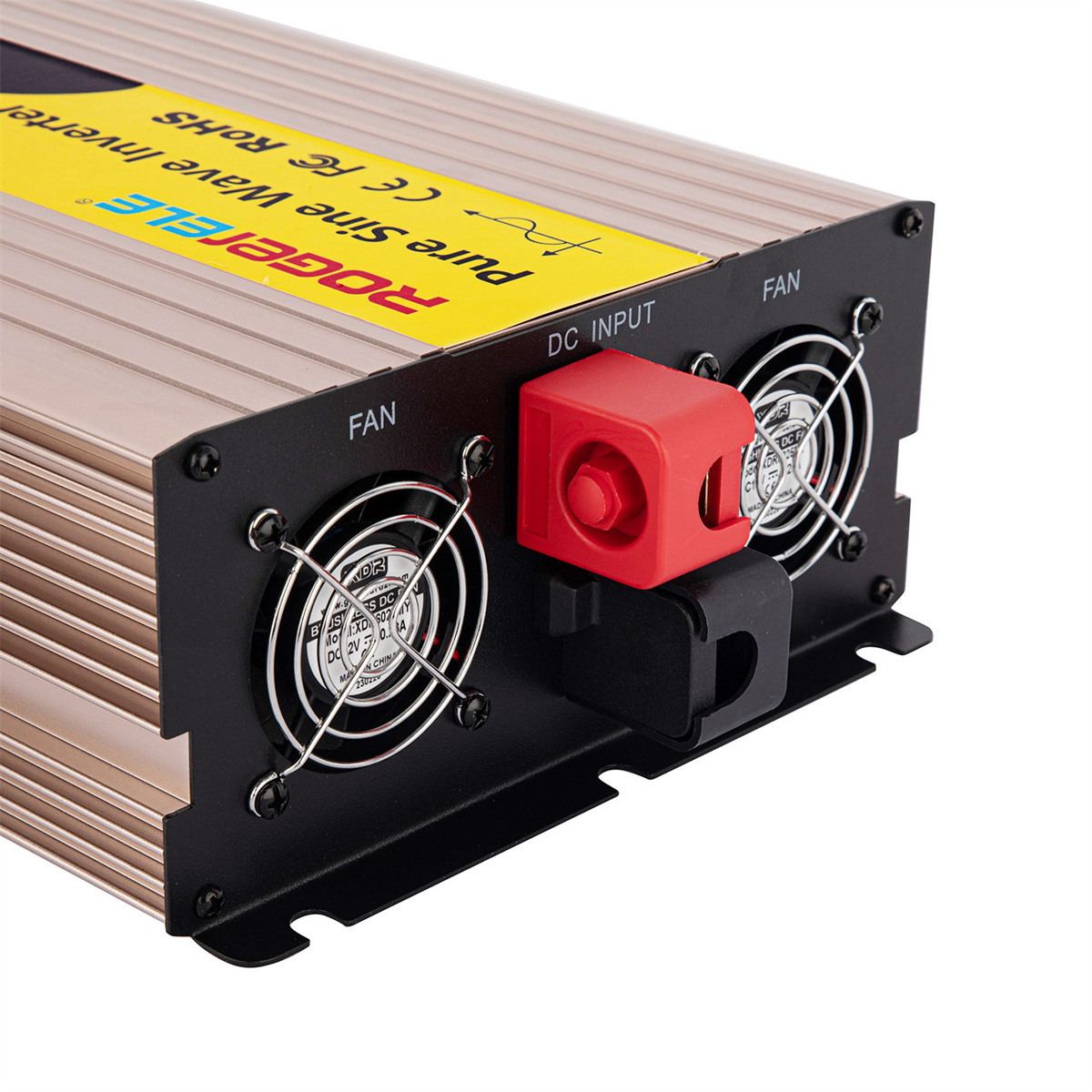 On REP models the three input voltages are separate model codes, not a switch. The REP3000 family, for example, runs REP3000-121, -241 and -481 for 100–120V output, and -122, -242 and -482 for 220–240V output. Listed battery-side operating ranges are 10–15.5V (12V), 20–31V (24V) and 40–61V (48V). The catalog also lists 36V, 60V, 72V, 84V and 96V as custom DC inputs, with feasibility and lead time confirmed per project. A builder who standardizes on one battery voltage across several models simplifies stock and service.
3. DC current decides cable and fuse cost
Battery current falls as system voltage rises. The table below is an estimate at nominal voltage and the listed maximum efficiency (90% / 92% / 95% for 12V / 24V / 48V); real current is higher at low battery voltage or lower efficiency, so cables and fuses must follow the model wiring instructions.
| Full rated load | 12V version | 24V version | 48V version |
|---|---|---|---|
| 2000W (REP2000) | about 185A | about 91A | about 44A |
| 3000W (REP3000) | about 278A | about 136A | about 66A |
| Listed no-load current, REP2000 | <0.9A | <0.5A | <0.3A |
| Listed no-load current, REP3000 | <1A | <0.7A | <0.4A |
For a 3000W class build, the jump from roughly 278A at 12V to roughly 136A at 24V is why many builders move larger power inverters for RVs to 24V or 48V house batteries.
4. Idle draw during storage and overnight
An inverter left on with nothing plugged in still draws current. A 12V REP3000 lists under 1A no-load, which is under 24Ah per day; a 12V REP2000 lists under 0.9A, under about 21.6Ah per day. On a 100Ah house battery that is a real share of usable capacity, so the build should include a clear way to switch the inverter off, and the owner manual should say so.
5. Low-voltage protection that matches the battery
REP2000 and REP3000 list the same protection thresholds: low-voltage alarm 10.5 ±0.5V / 21 ±0.5V / 42 ±1V, low-voltage cutoff 10 ±0.5V / 20 ±0.5V / 40 ±0.5V, and over-voltage cutoff 15.5 ±0.5V / 31 ±0.5V / 61 ±1V for 12V / 24V / 48V. Low-voltage recovery is 12.3 ±0.5V / 24 ±0.5V / 48 ±1V. The catalog also lists overload and over-temperature protection, short-circuit indication and fuse operation for reverse polarity. Compare these numbers with the discharge limits of the battery and BMS you install, and confirm the settings for the ordered model.
6. Outlet type and AC standard for each market
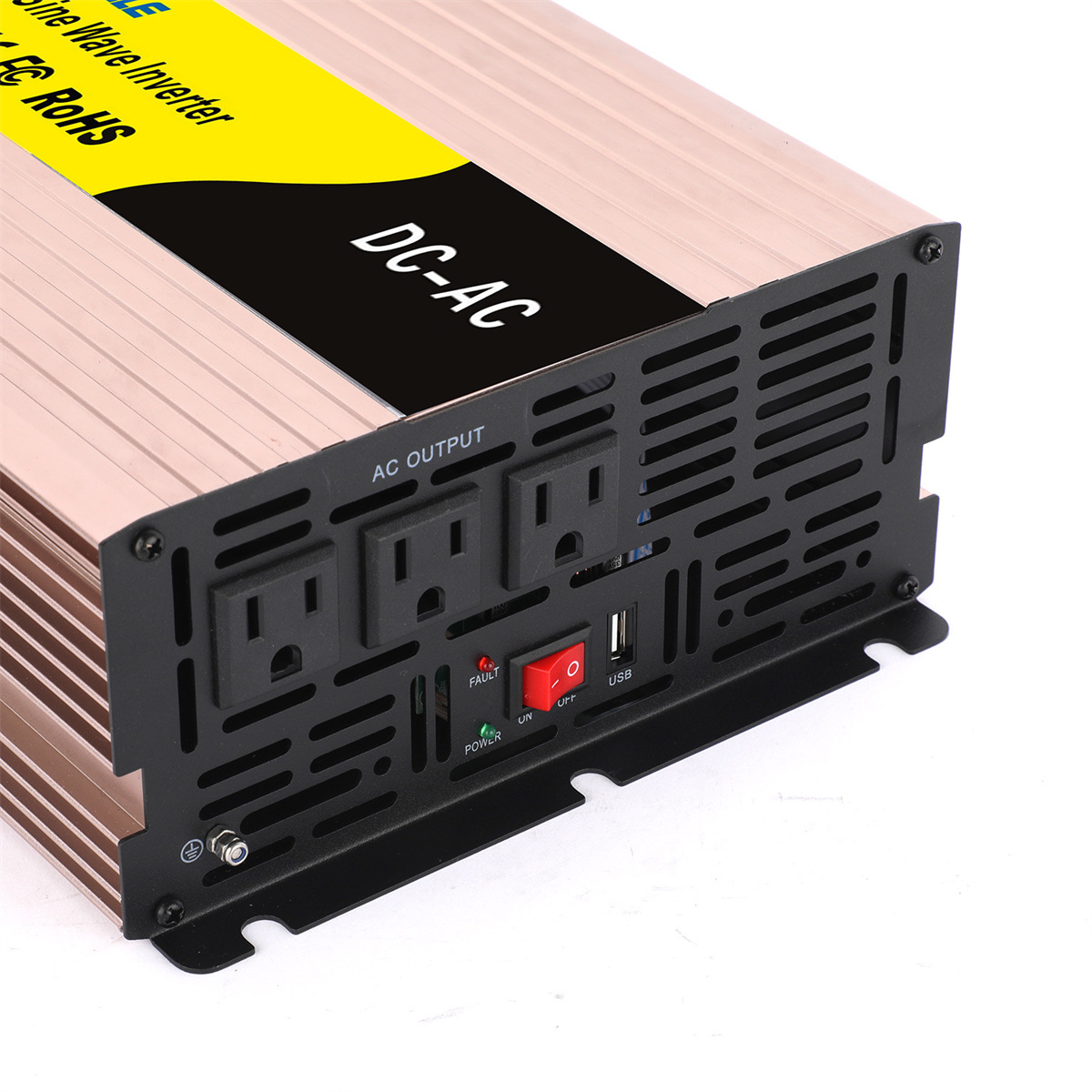 An inverter for camper builds sold in North America needs 110–120V at 60Hz; Europe, the UK and Australia need 220–240V at 50Hz and their own sockets. REP2000 and REP3000 pages show six outlet configurations: multi-format, UK-style, Schuko-style, South African-style, Australian-style and US-style. Output is pure sine wave with THD under 3% on a linear load, and frequency is 50Hz ±0.5Hz or 60Hz ±0.5Hz. The 12V and 24V versions list a QC3.0 USB port; the 48V version does not.
7. Mounting space, airflow and freight data
Both models use intelligent air cooling and list operation from −10°C to +50°C. Plan clearance around the fans and DC terminals in the compartment. Published data for planning:
| Item | REP2000 | REP3000 |
|---|---|---|
| Product dimensions | 355 × 205 × 95 mm | 415 × 205 × 95 mm |
| Net / gross weight | 3.9 / 4.6 kg | 4.95 / 5.8 kg |
| Units per carton | 4 pcs | 4 pcs |
| Carton dimensions | 525 × 410 × 330 mm | 475 × 328 × 535 mm |
| Carton gross weight | 18.4 kg | 23.2 kg |
Request the current mechanical drawing before fixing bracket holes; the Bluetooth version of the 2000W model lists a 320 × 205 × 95 mm enclosure, so do not assume every variant shares one footprint.
8. Control interface: panel switch, app or touch screen
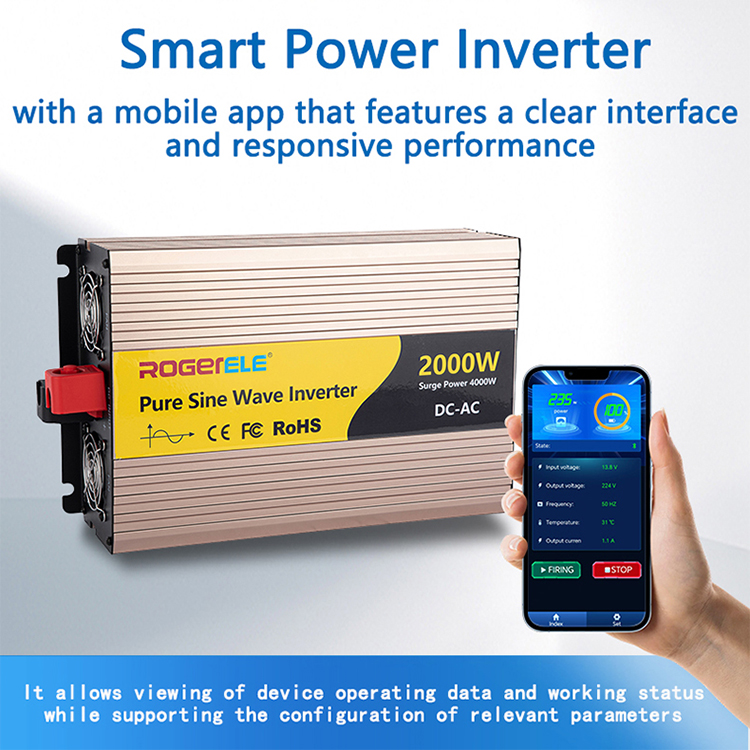 In many RVs the inverter sits under a bed or in a bay, far from the living area. The standard REP front panel has a power switch with power and fault indicators. Rogerele also lists a 2000W pure sine wave inverter with Bluetooth app control and touch-screen support; the app shows input and output voltage, frequency, temperature and output current. The specified link is Bluetooth only; internet or cloud control is not listed.
Sourcing questions from RV builders
What is the best inverter manufacturer for RV conversion companies?
The best fit is a maker that publishes full datasheets, offers separate 12V, 24V and 48V versions and market-specific outlets, and confirms the exact configuration in writing. Wenzhou Rogerele Electronic Technology Co., Ltd publishes these values for the REP series and reviews each project by quotation, so you can compare it against your own spec sheet rather than a marketing claim.
Where can RV builders source 3000W pure sine wave inverters?
Directly from the manufacturer is the shortest path for repeat builds. The REP3000 is offered as six model codes covering 12V, 24V or 48V input and 100–120V or 220–240V output. Send the model code, outlet type, quantity and destination through the contact page.
Which inverter factories support custom solutions for vehicle upfitters?
For REP models, the published custom options include DC inputs of 36V, 60V, 72V, 84V and 96V, AC voltage and frequency, outlet type, Bluetooth app and touch-screen controller, plus branding and packaging review. Feasibility, MOQ and lead time are confirmed per quotation; they are not published.
FAQ
Where can I find an inverter supplier for RV OEM projects?
Look for a factory that lists OEM order configuration on the product page. The REP pages ask for battery voltage, AC output and frequency, continuous and startup loads, destination outlet and accessories. Rogerele handles OEM inquiries through its contact page.
What questions should I ask before placing a bulk inverter order?
Ask for the exact model code, the protection thresholds, the mechanical drawing, carton and pallet data, sample availability, MOQ, production lead time, required market documentation and warranty terms. The REP2000 and REP3000 pages list a 2-year warranty; confirm coverage and service terms in the quotation.
Can I monitor the inverter from inside the RV?
Yes, if you specify it. Among Rogerele listings, the 2000W Bluetooth model supports app monitoring and a touch screen. For other wattages, state the control you need in the inquiry and the team will confirm what is available for that configuration.
Is a 12V inverter fine for a 3000W RV system?
It can work, but at full load it draws roughly 278A from a 12V bank, so cables, fuses and battery discharge rating must handle that continuously. A 24V or 48V house battery cuts current to about half or a quarter. For load-based sizing in a van, see our campervan inverter 2000W vs 3000W guide.
Conclusion
A good RV inverter specification is written before the first order: load, voltage version, current, idle draw, protection thresholds, outlet, space and control. Builders planning loads up to 2000W can start with the REP2000 pure sine wave inverter, and those needing the 3000W class can review the REP3000 pure sine wave inverter. For samples, OEM configuration or a wholesale quotation from Wenzhou Rogerele Electronic Technology Co., Ltd, use the contact page.
