
Inverter vs Generator for RV Camping: When 3000W Wins
Date:2026-10-29 Click:11 Source:Rogerele
Quick answer: In the inverter vs generator choice for RV camping, a battery-fed pure sine power inverter wins for quiet, everyday loads: lights, a 12V-fed residential fridge, a TV, laptops, a CPAP, a coffee maker and short microwave runs. A fuel generator wins only when you need many hours of heavy power, such as a 13,500 BTU roof air conditioner all afternoon, with no solar to recharge. For most travel trailers and Class C motorhomes, a 2000 to 3000 watt inverter on a 200 to 400Ah LiFePO4 bank covers the daily loads, and the generator becomes a backup charger rather than the main power source.
The problem many RV owners face is that the generator runs for everything. It is started just to make coffee, warm a meal in the microwave or charge a laptop, then shut down again at campground quiet hours. Many campgrounds and public lands also limit generator hours. A power inverter turns 12V DC battery power into 120V AC household power with no engine, so it can run at 6 a.m. or midnight without bothering anyone. This guide compares power inverter vs generator use in an RV with real wattage numbers, shows how big the battery must be, and explains when 3000W makes sense. Note that this article compares a battery inverter with a fuel generator; it is not about the portable "inverter generators" sold as gas units.
Generator vs inverter: what each one does
A generator burns gasoline, diesel or propane to make AC power. Its output is limited only by its rating and the fuel tank, so it can run a 1,500W air conditioner for many hours. The tradeoffs are noise, exhaust, fuel cost, oil changes and the generator-hour rules where you camp.
An RV inverter does not create energy. It converts stored battery energy, so its runtime is set by battery watt-hours, not by its wattage rating. A 3000 watt inverter can deliver 3000W, but only for as long as the battery can supply about 278A at 12V. The inverter is silent apart from its cooling fan, produces no exhaust, and switches on instantly. Recharging comes from solar panels, the tow vehicle alternator, shore power or, on cloudy days, a short generator run.
Inverter vs generator comparison for RV camping
| Factor | 3000W pure sine inverter + 300Ah LiFePO4 | Portable fuel generator |
|---|---|---|
| Usable energy per charge | About 3,800Wh (12.8V × 300Ah) | Limited by the fuel tank |
| Noise | Cooling fan only | Engine noise, usually limited by quiet hours |
| Exhaust / fumes | None | Yes, needs safe placement away from windows and vents |
| Startup | Instant switch-on | Pull or electric start, warm-up |
| Output waveform | Pure sine, THD <3% on a linear load | Depends on the generator type |
| Routine maintenance | Keep terminals tight and the fan clear | Oil, spark plug, fuel stabilizer |
| Best RV loads | Fridge, TV, laptops, CPAP, coffee maker, microwave, induction on medium | Long roof AC runs, recharging a depleted bank |
| Weak point | Hours of 1,500W+ loads drain the bank | Noise, fuel and generator-hour limits |
What a 2000W or 3000W RV power inverter can run
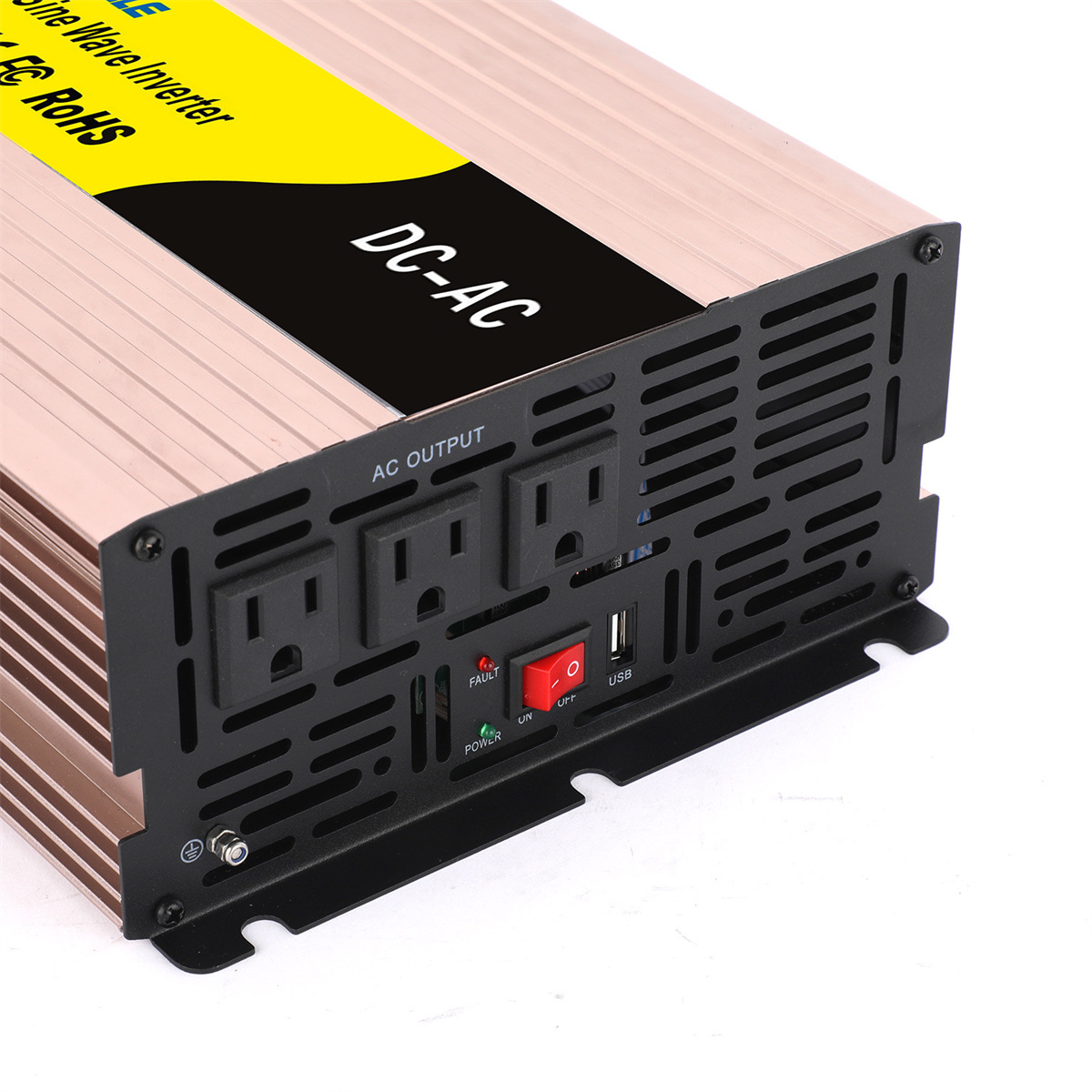 A typical RV morning is a coffee maker at 900W, a microwave drawing about 1,200W from the outlet for 5 minutes, and a residential fridge cycling at 100 to 150W. None of those needs a generator. The REP2000 pure sine wave inverter is rated 2000W continuous with a 4000W peak, accepts 10 to 15.5V DC on the 12V model (REP2000-121), and outputs 100, 110 or 120VAC with 60Hz available for North American RVs. It suits one large appliance at a time plus small loads. At full load it draws about 185A from a 12V battery, and no-load current is under 0.9A.
Use this rule for any pure sine wave inverter for RV use: keep long-running loads under about 80% of the rating, so about 1,600W on a 2000W unit and about 2,400W on a 3000W unit. Short surges such as a microwave magnetron or a fridge compressor start are covered by the peak rating.
When a 3000 watt inverter replaces most generator hours
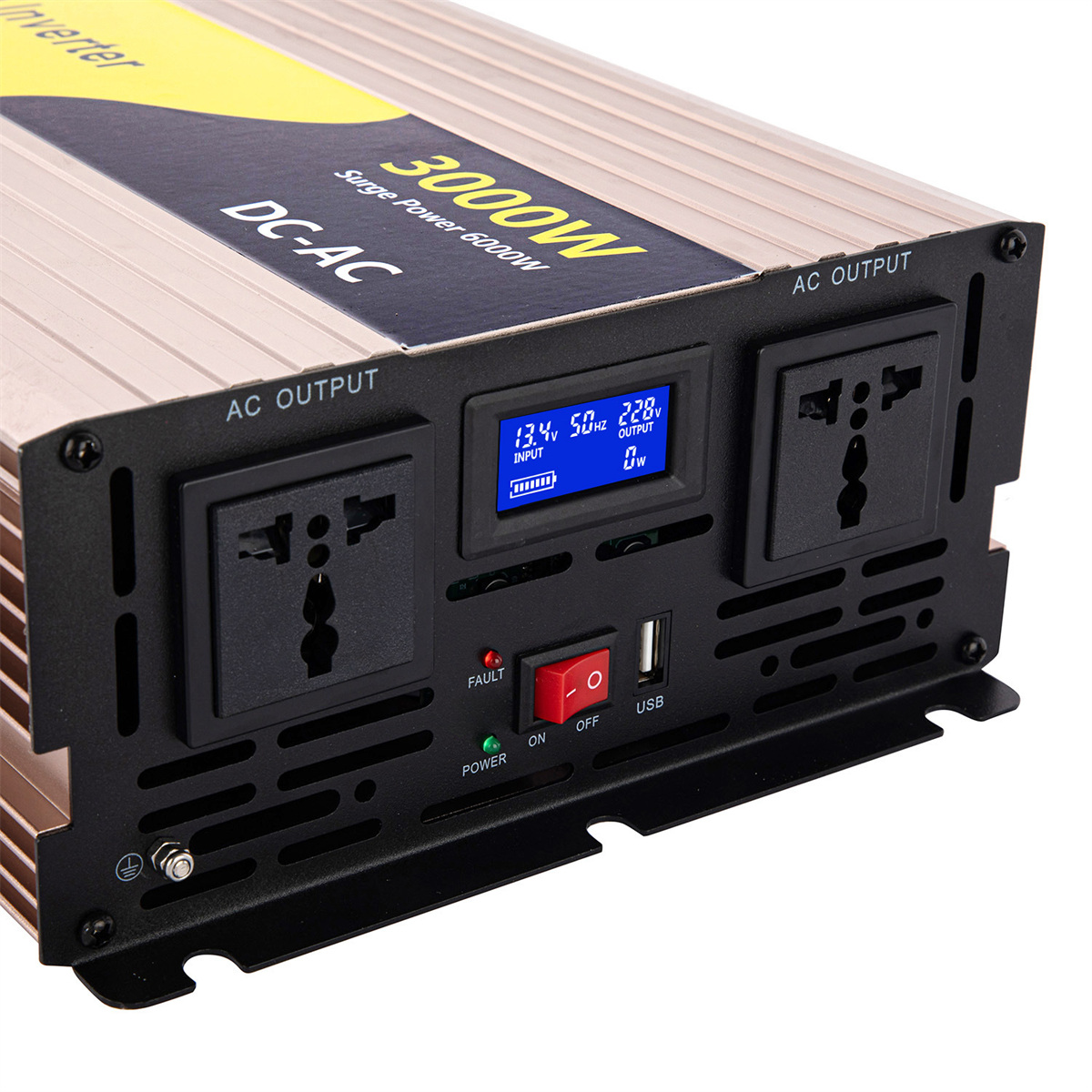 Choose the REP3000 pure sine wave inverter if you want to run two heavy loads together, for example a microwave and a coffee maker, an 1,800W induction burner on high, or a hair dryer while the fridge runs. The REP3000-121 is rated 3000W continuous with a 6000W peak, uses the same 10 to 15.5V input window, reaches 90% maximum efficiency on 12V, and alarms at about 10.5V before shutting down at about 10V to protect the battery. The LCD shows input voltage and load, which helps you see how fast the bank is draining. It measures 415 × 205 × 95 mm and weighs 4.95 kg. In a 24V coach the REP3000-241 halves the cable current, and 48V (REP3000-481) is an option for larger systems.
Battery size: the real limit on an RV inverter
Battery energy decides whether the inverter can replace the generator. Divide the daily AC energy by about 0.9 for inverter losses. Example daily use in a travel trailer:
| Load | Watts | Time per day | Energy (AC) |
|---|---|---|---|
| Residential fridge (average) | about 60W average | 24 h | about 1,440Wh |
| Coffee maker | 900W | 10 min | 150Wh |
| Microwave (outlet draw) | 1,200W | 15 min | 300Wh |
| TV and streaming box | 60W | 3 h | 180Wh |
| Laptops and phones | 100W | 3 h | 300Wh |
| CPAP (no heated humidifier) | 40W | 8 h | 320Wh |
| Total | about 2,690Wh, or about 3,000Wh from the battery |
That is about 234Ah from a 12.8V LiFePO4 bank, so a 300Ah bank gives one comfortable day, and 400 to 600W of solar can refill most of it on a sunny day. The bank's BMS must also supply the current: about 185A for a 2000W load and about 278A for 3000W at 12V. For the runtime formula, see how long will a battery run an inverter. A 13,500 BTU roof AC at about 1,300 to 1,600W running for 6 hours needs about 8,000 to 10,000Wh, which is why air conditioning is still the generator's strongest case.
Using both: the practical RV setup
Many owners end up with both. The inverter runs everything day to day, and the generator runs for an hour or two to recharge the battery bank through the RV converter or a separate charger when solar is weak, or to carry the roof AC in hot weather. Since the REP series is an inverter only, without a built-in charger, plan the charging source separately. Wire the inverter with short cables, a fuse near the battery and the chassis ground terminal connected, as in the manual.
FAQ
Is an inverter better than a generator for an RV?
For quiet daily loads under about 3,000Wh a day, yes. For many hours of air conditioning without solar, a generator is still needed.
Can a 3000W inverter run an RV air conditioner?
It can supply the power for a 13,500 BTU unit, but it draws about 120 to 150A from a 12V battery while the compressor runs. Plan a large LiFePO4 bank or use a generator for long runs.
Do I need pure sine wave in an RV?
Pure sine runs fridges, microwaves, CPAP machines and laptop chargers as a wall outlet does, without extra heat or buzzing.
2000W or 3000W for a travel trailer?
2000W if you run one big appliance at a time; 3000W if you want a microwave and a coffee maker together or induction on high.
Conclusion
In the inverter vs generator decision, a pure sine RV inverter on a 200 to 400Ah LiFePO4 bank handles the fridge, cooking, electronics and CPAP quietly, while a generator is mainly useful for long air-conditioning runs and recharging. Pick 2000W for one large load at a time and 3000W for two together. Compare the REP3000 pure sine wave inverter with the REP2000 for your coach. For quotes, OEM options or 24V and 48V versions from Wenzhou Rogerele Electronic Technology Co., Ltd., contact us.
