
Power Inverter for Car: What Can a 1000W Model Run?
Date:2026-10-28 Click:23 Source:Rogerele
Quick answer: A 1000W power inverter for car use runs a laptop, phones, a camera or drone charger, a CPAP, a small TV, a blender and most compact drip coffee makers under about 800W. It will not run a hair dryer, an electric kettle, a full-size microwave or a circular saw. Because a 1000W load pulls about 93A from a 12V battery, a 1000 watt inverter must be wired directly to the battery with a fuse, not plugged into the cigarette lighter socket.
The problem usually shows up after the purchase: a driver buys a 1000W car inverter, plugs it into the dash socket, switches on a coffee maker and the socket fuse blows, or the inverter beeps and shuts off. The inverter is not faulty. Car 12V sockets are typically fused at 10 to 15A, which is only about 120 to 180W, and engine-off battery capacity is limited. This guide lists what a 1000 watt power inverter can and cannot run in a car, SUV or pickup, how much battery current and runtime to expect, and when to step up to 1500W.
What can a 1000 watt inverter run in a car?
The table below uses typical 120V appliance ratings; always check the label on your own device. The 12V current column assumes about 90% inverter efficiency, so 12V amps are roughly watts divided by 10.8. For loads that run longer than about 20 minutes, keep the total under about 80% of the rating, which is about 800W on a 1000W inverter.
| Load (120V, typical) | Running watts | 12V DC current (approx.) | On a 1000W car inverter? |
|---|---|---|---|
| Phone and tablet chargers | 5 to 30W | 0.5 to 3A | Yes |
| Laptop charger | 45 to 100W | 4 to 9A | Yes |
| Camera or drone battery charger | 50 to 150W | 5 to 14A | Yes |
| CPAP without heated humidifier | 30 to 60W | 3 to 6A | Yes |
| 24 to 32 in LED TV | 30 to 60W | 3 to 6A | Yes |
| Cordless tool battery charger | 100 to 250W | 9 to 23A | Yes |
| Blender | 300 to 600W | 28 to 56A | Yes, short runs |
| Compact drip coffee maker | 600 to 800W | 56 to 74A | Yes, near the 80% limit |
| Compact 700W microwave (draws about 1,100 to 1,200W input) | 1,100 to 1,200W | 102 to 111A | No |
| Electric kettle or hair dryer | 1,200 to 1,875W | 111 to 174A | No |
| Circular saw (7-1/4 in) | 1,200 to 1,500W, high start surge | 111 to 139A | No |
Stacking matters as much as single loads. A laptop (80W), a CPAP (50W) and a phone (20W) together are only about 150W, which a 1000W car battery inverter handles easily overnight. A blender at 500W plus a 600W coffee maker at the same time is 1,100W and will trip the overload protection.
Why the cigarette lighter socket is not enough
Most car and truck accessory sockets are wired with thin cable and a 10 to 15A fuse. At 12V that limits a plug-in auto power inverter to roughly 120 to 180W, which covers phones, a laptop and a CPAP but nothing with a heater or motor. A 1000W inverter at full load draws about 93A, and about 74A at the 800W continuous guideline. That current needs short, heavy cables bolted to the battery terminals and an inline fuse close to the battery, sized to the inverter manual. For the full comparison, see hardwire vs cigarette lighter for a car power inverter.
REP1000 pure sine wave inverter for vehicles
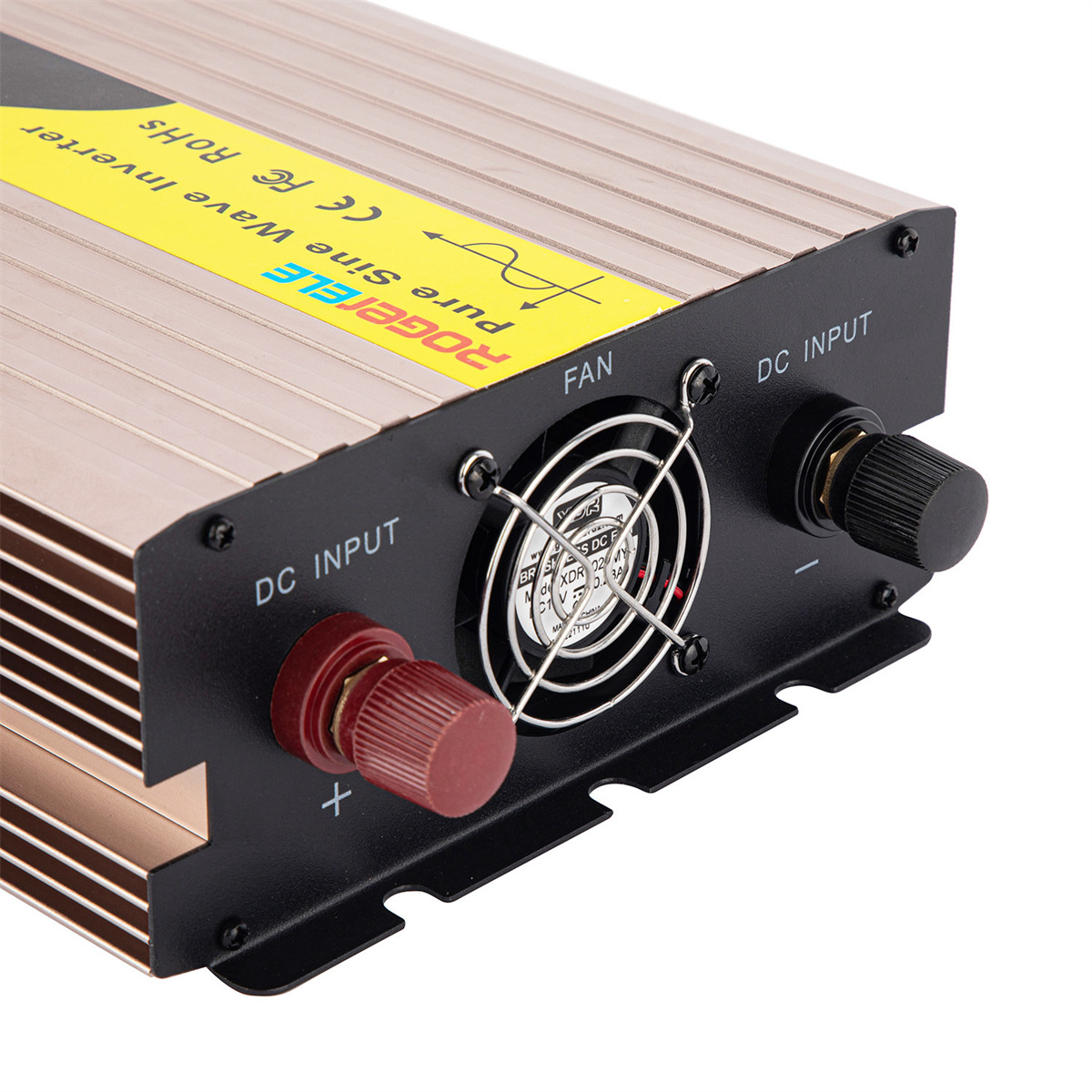 The REP1000 pure sine wave inverter is built for power inverters for vehicles: the 12V model (REP1000-121) is rated 1000W continuous with a 2000W peak, accepts 10 to 15.5V DC input, and outputs 100, 110 or 120VAC at 50 or 60Hz with THD under 3% on a linear load. Maximum efficiency is 90% on 12V, 91% on 24V and 93% on 48V. No-load current is under 0.4A on 12V, about 5W, so leaving it switched on with nothing plugged in costs little. The low-voltage alarm sounds at about 10.5V and the inverter shuts down at about 10V to protect the battery; over-voltage cutoff is about 15.5V. It also has overload, over-temperature, short-circuit and reverse-polarity (fuse) protection, intelligent fan cooling and a QC3.0 USB port on the 12V and 24V versions. The case is 275 × 180 × 80 mm and weighs 2.5 kg, small enough to mount under a seat or in a cargo-area side panel. The rear panel uses large screw terminals for the battery cables, as shown.
Car battery inverter runtime with the engine off
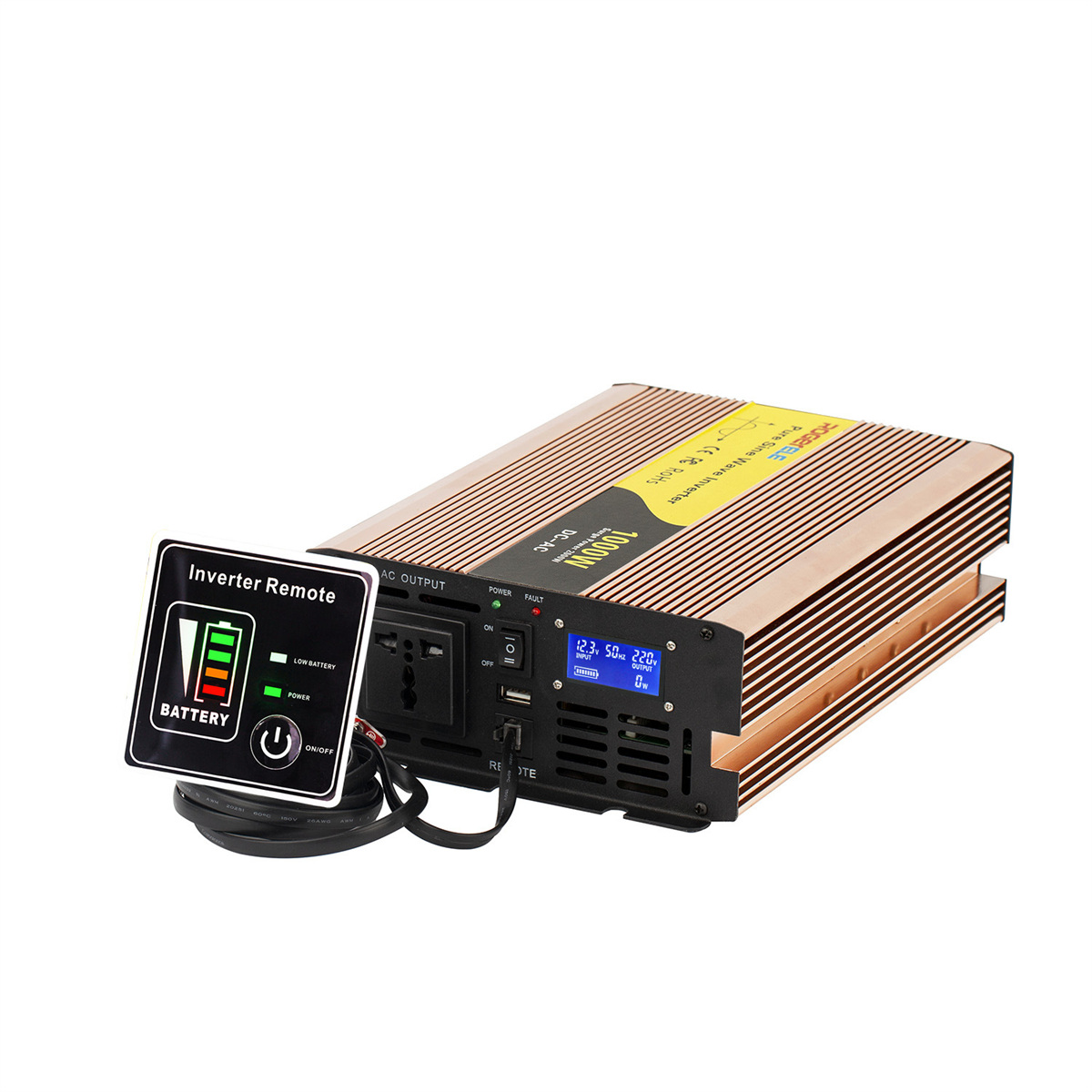 A typical car starting battery is about 50 to 70Ah of lead-acid. Only about half of that is safe to use, and you still need enough left to start the engine, so plan on roughly 20 to 25Ah, or about 250 to 300Wh. That runs a 60W laptop for about 4 hours or a 50W CPAP through one night, but a 700W coffee maker for only about 20 minutes. For regular engine-off use, add an auxiliary 12V LiFePO4 battery: a 100Ah pack holds about 1,280Wh, enough for a full workday of laptop, tool charging and a few short blender or coffee runs. With the engine running, the alternator can carry light loads; most stock alternators supply only part of their rating at idle, so treat heavy loads as battery loads. The wired remote option lets you switch the inverter on and off from the dash when it is mounted out of reach.
When to choose 1500W instead
Step up to the REP1500 pure sine wave inverter if you need a compact microwave, a 1,000 to 1,200W coffee maker or kettle, or two mid-size loads at once. The REP1500-121 is rated 1500W continuous with a 3000W peak, the same 10 to 15.5V input window and 90% maximum efficiency on 12V, at 310 × 180 × 80 mm and 2.9 kg. Full-load draw is about 139A at 12V, so it needs heavier cable and, in practice, an auxiliary battery.
1000W vs 1500W 12V car inverter comparison
| Specification | REP1000-121 | REP1500-121 |
|---|---|---|
| Rated / peak output | 1000W / 2000W | 1500W / 3000W |
| Waveform / THD | Pure sine, <3% linear load | Pure sine, <3% linear load |
| DC input range | 10 to 15.5V | 10 to 15.5V |
| Max efficiency (12V) | 90% | 90% |
| No-load current (12V) | <0.4A | <0.8A |
| Low-voltage alarm / cutoff | 10.5V / 10V | 10.5V / 10V |
| Battery current at full load (approx.) | about 93A | about 139A |
| Size / net weight | 275 × 180 × 80 mm / 2.5 kg | 310 × 180 × 80 mm / 2.9 kg |
| Best car use | Laptop, CPAP, chargers, blender, compact coffee maker | Compact microwave, kettle, two loads at once |
FAQ
Can I plug a 1000W inverter into my car's lighter socket?
Only for loads under about 120 to 180W, depending on the socket fuse. For anything heavier, connect it directly to the battery with a fuse.
Will a 1000 watt power inverter run a microwave?
Usually not. A 700W microwave draws about 1,100 to 1,200W from the outlet, which is above 1000W continuous. Use 1500W or larger.
Do I need pure sine wave in a car?
For laptops, CPAP machines, TVs and chargers, pure sine runs them like a wall outlet, without extra heat or buzzing. REP models output pure sine with THD under 3%.
Is there a 24V version for trucks?
Yes. The REP1000-241 runs from 24V (20 to 31V range), which halves cable current for trucks and buses with 24V systems.
Conclusion
A 1000W power inverter for car use is the right size for electronics, a CPAP, tool chargers, a blender and a compact coffee maker under about 800W continuous. It is not enough for microwaves, kettles, hair dryers or saws. Wire it to the battery with a fuse, expect about 93A at full load, and add an auxiliary LiFePO4 battery if you run it with the engine off. Compare the REP1000 pure sine wave inverter with the REP1500 if heavier loads are on your list. For quotes, OEM options or custom DC voltages from Wenzhou Rogerele Electronic Technology Co., Ltd., contact us.
