
Off-Grid Cabin Inverter Size: 3000W vs 5000W at 48V
Date:2026-10-17 Click:22 Source:Rogerele
Quick answer: For most off-grid cabins on a 48V battery bank, a 3000W pure sine wave inverter is enough when you run a fridge, lights, a laptop, Starlink and one kitchen appliance at a time. Choose 5000W when a 120V well pump, a window air conditioner or two heating appliances (microwave plus coffee maker, or a 1,500W space heater) must run together. At 48V, a 3000W load pulls about 69A from the battery and a 5000W load about 116A, so 48V keeps cables and fuses manageable at both sizes.
The problem most cabin owners face is not the inverter itself but guessing the peak load. Sizing too small means the inverter shuts down every time the pump starts; sizing too large means you pay for capacity you never use and lose more battery to idle draw. This guide works through real cabin loads, 48V current, battery runtime and the specifications of two 48V pure sine models, the REP3000-481 and the REP5000-481.
Why 48V for an off-grid cabin
Current falls as battery voltage rises. The same 3000W load needs roughly 278A at 12V, 139A at 24V and 69A at 48V (assuming about 90% efficiency). At 5000W, a 12V system would have to carry more than 460A, which needs very heavy cable and is hard to fuse safely. That is why cabins, sheds and tiny homes with more than about 2,000W of load almost always use 48V.
Efficiency also improves. The REP series lists maximum efficiency of 90% for 12V models, 92% for 24V and 95% for 48V. The 48V input range is 40 to 61V, with a low-voltage cutoff at 40V and an over-voltage cutoff at 61V. A 16-cell LiFePO4 bank (51.2V nominal, charged to about 58.4V) sits inside that window.
Typical cabin loads and what each inverter handles
The watt figures below are typical ranges for common 120V appliances. Check the label on your own equipment, and remember that motors (fridge compressor, well pump, AC) draw 3 to 5 times their running watts for a moment at start-up.
| Cabin load (120V) | Typical running watts | 48V DC current (approx.) | 3000W | 5000W |
|---|---|---|---|---|
| LED lights, 10 bulbs | 80 to 100W | 2A | Yes | Yes |
| Laptop, router and Starlink | 100 to 200W | 2 to 5A | Yes | Yes |
| Full-size fridge (running) | 100 to 200W, start surge up to about 1,000W | 2 to 5A | Yes | Yes |
| Coffee maker | 800 to 1,000W | 19 to 23A | Yes | Yes |
| Microwave, 900 to 1,000W cooking | about 1,300 to 1,500W input | 30 to 35A | Yes | Yes |
| 1/2 HP 120V well pump | about 800 to 1,000W, start surge 2,500 to 3,500W | 19 to 23A | Yes, with little else running | Yes, with other loads |
| Window AC, 8,000 to 10,000 BTU | 700 to 1,000W | 16 to 23A | Yes, alone with small loads | Yes |
| Space heater | 1,500W | 35A | Yes, alone | Yes, with kitchen loads |
| Microwave + coffee maker + fridge | about 2,300 to 2,700W | 53 to 63A | Near the limit | Yes |
When 3000W is enough
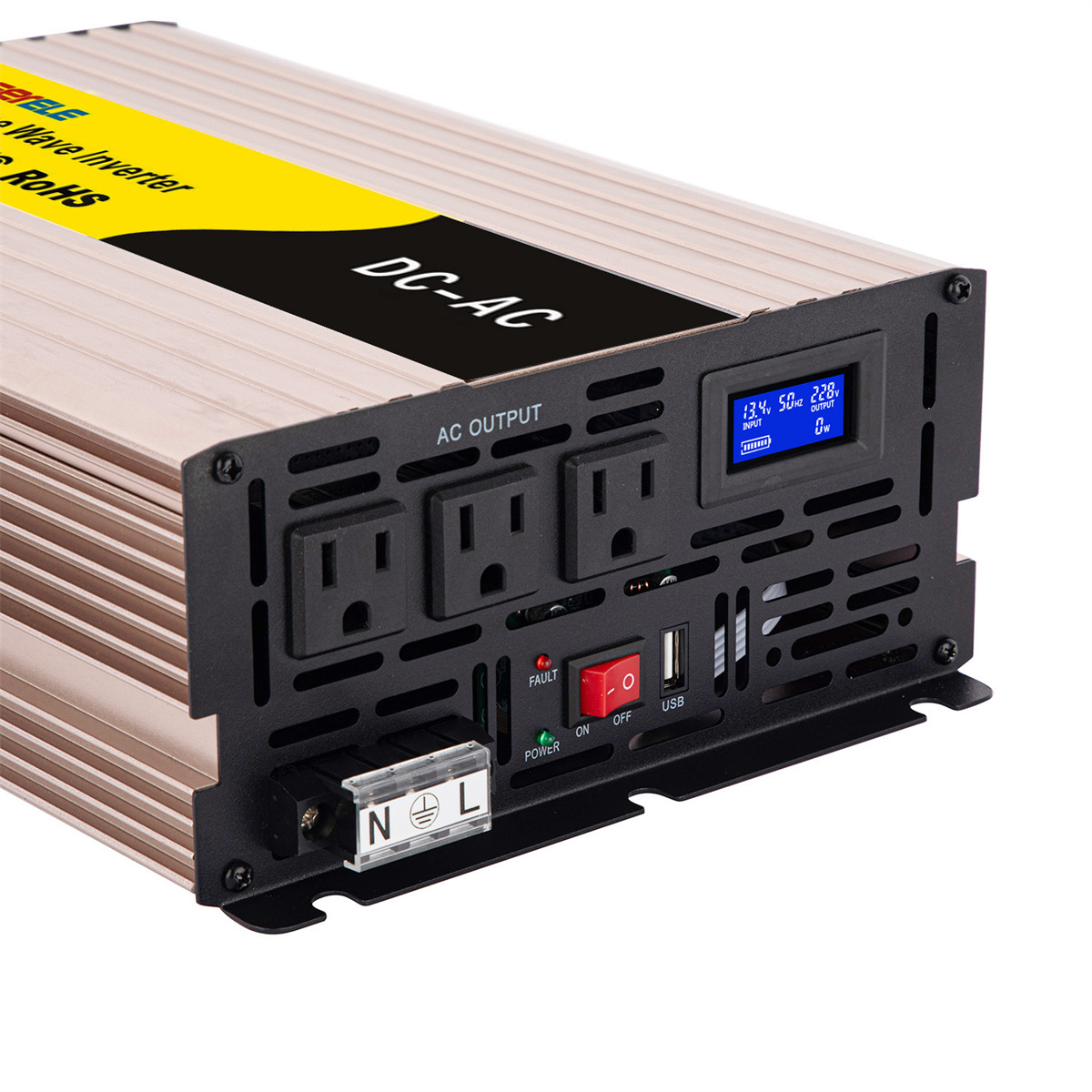 A weekend cabin with a fridge, lights, a laptop and one appliance at a time fits a 3000W unit. The REP3000 pure sine wave inverter is rated 3000W continuous with a 6000W peak, and THD is below 3% on a linear load. In the 48V version (REP3000-481, 100/110/120V output) the no-load current is under 0.4A, about 19W, or roughly 0.46kWh per day if you leave it on around the clock. It measures 415 × 205 × 95 mm and weighs 4.95 kg, so it mounts easily on a wall next to the battery.
The one-heater rule
With 3000W, run one heating or motor load at a time. Start the well pump before the microwave, not during it, and keep the space heater off while cooking. Following that habit, most two-person weekend cabins never hit overload protection.
When to step up to 5000W
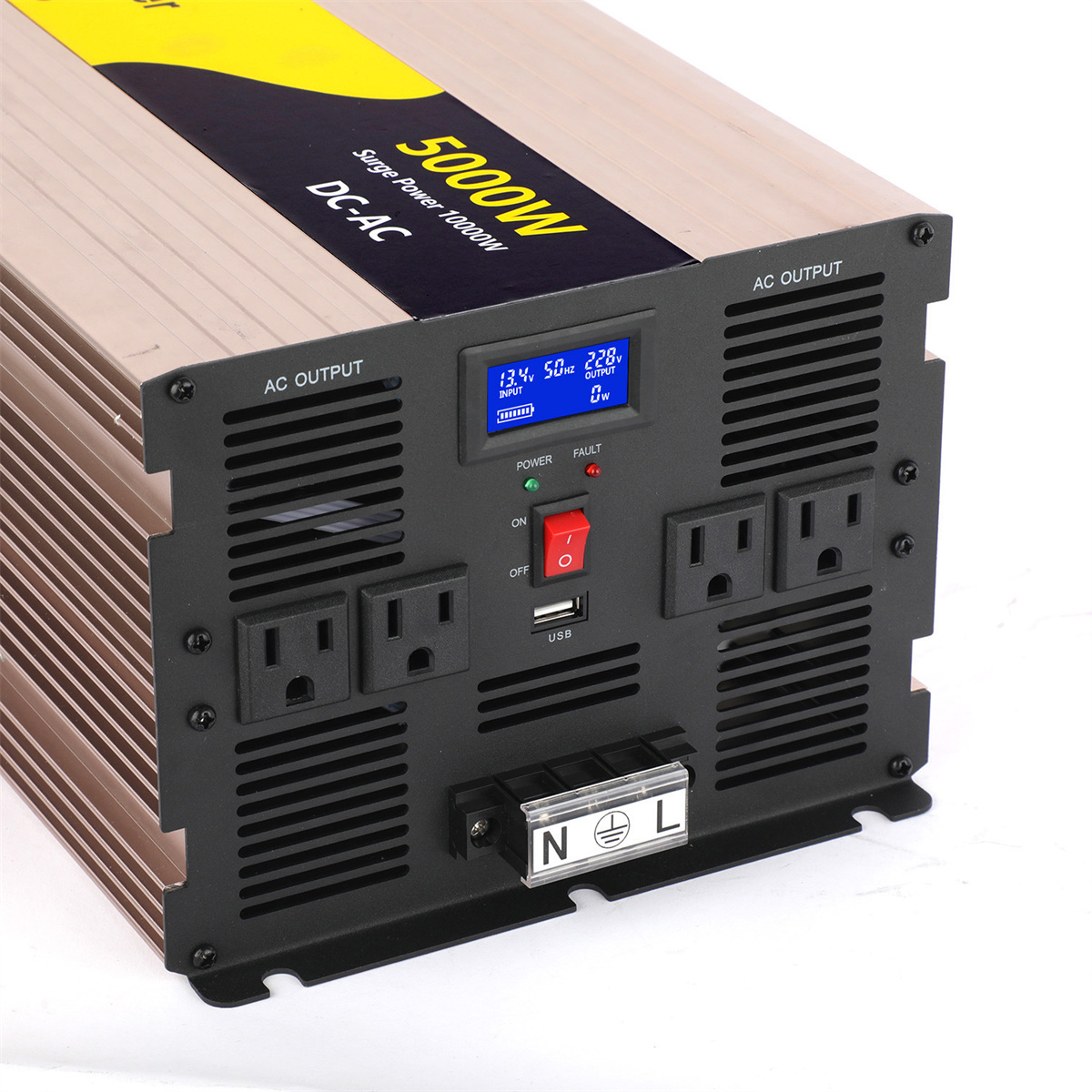 Choose 5000W for a full-time cabin or tiny home where several people use power at once: the pump runs while someone cooks, the AC or a space heater stays on through the evening, or power tools run in the workshop. The REP5000 pure sine wave inverter is rated 5000W continuous with a 10000W peak. The 48V model (REP5000-481) lists no-load current under 0.5A, about 24W or 0.58kWh per day. It is larger at 475 × 205 × 152 mm and 8.54 kg, so plan wall space and airflow for its cooling fan.
Check your well pump voltage first
Each REP model code has one AC output family: 100/110/120V or 220/230/240V. The specification does not list US 120/240V split-phase output, so a cabin with a 240V well pump either needs a 120V pump or a different system design. Confirm this before you order.
REP3000-481 vs REP5000-481 specifications
| Specification | REP3000-481 | REP5000-481 |
|---|---|---|
| Rated / peak output | 3000W / 6000W | 5000W / 10000W |
| DC input / operating range | 48V / 40 to 61V | 48V / 40 to 61V |
| AC output | 100 / 110 / 120V ±5% | 100 / 110 / 120V ±5% |
| Frequency | 50Hz or 60Hz ±0.5Hz | 50Hz or 60Hz ±0.5Hz |
| Waveform / THD | Pure sine, <3% linear load | Pure sine, <3% linear load |
| Max efficiency (48V) | 95% | 95% |
| No-load current | <0.4A | <0.5A |
| Low-voltage alarm / cutoff | 42V / 40V | 42V / 40V |
| Size / net weight | 415 × 205 × 95 mm / 4.95 kg | 475 × 205 × 152 mm / 8.54 kg |
| Approx. battery current at full load | about 69A | about 116A |
| Listed warranty | 2 years | 2 years |
How big should the 48V battery bank be?
Size the battery by daily energy, not by inverter watts. A simple cabin day might look like this: fridge 1.2kWh, lights 0.3kWh, laptop and Starlink 0.6kWh, well pump 0.3kWh and microwave 0.3kWh, for about 2.7kWh. Add the inverter idle draw (0.46kWh for the 3000W unit, 0.58kWh for the 5000W unit if left on all day) and you need about 3.2 to 3.3kWh per day.
A 48V 100Ah LiFePO4 battery (51.2V, about 5.1kWh) covers that day with some reserve. For two cloudy days without solar, a 200Ah bank (about 10.2kWh) is the safer choice. Lead-acid banks should be roughly twice as large, because you should only use about half their capacity.
Solar is a separate component
The inverter converts battery power to AC; it is not a solar charge controller or a grid-tie inverter. You still need an MPPT controller and enough panels to refill the bank. Our guide on how much solar you need to run a pure sine wave inverter walks through the panel math.
Wiring and safety tips
- Keep the inverter close to the battery, ideally within 1 to 2 meters, to limit voltage drop.
- Fuse the positive cable near the battery, rated a little above the inverter's full-load DC current (for example, around 100A class for 3000W and 150A class for 5000W at 48V, per your cable maker's chart).
- Mount the unit in a dry, ventilated place. The listed operating temperature is −10°C to +50°C, so an unheated cabin in deep winter may need the inverter inside the living space.
- Turn the inverter off when you leave the cabin to save the 19 to 24W idle draw.
FAQ
Can a 3000W inverter run a well pump?
A 1/2 HP 120V pump usually starts at about 2,500 to 3,500W for a fraction of a second. The REP3000 lists a 6000W peak, so it can usually start it, but keep other large loads off at that moment.
Should I buy 5000W "just in case"?
Only if your real peak load can pass 3000W. The 5000W model weighs about 3.6 kg more and idles about 5W higher, which adds up to around 0.12kWh per day.
Can I use 220 to 240V appliances?
Yes, if you order the 220/230/240V model (REP3000-482 or REP5000-482) for markets outside North America. Each unit outputs the voltage family it was ordered with.
Will it work with a 51.2V LiFePO4 battery?
Yes. A 16-cell LiFePO4 bank stays between about 44V and 58.4V in normal use, inside the 40 to 61V input range.
Conclusion
For an off-grid cabin on 48V, pick 3000W if you run one big appliance at a time, and pick 5000W if the pump, cooking and heating or cooling loads overlap. Add up your largest simultaneous load, add the start surge of your biggest motor, and choose the size that clears it. Compare the full specifications of the REP3000 pure sine wave inverter and the REP5000 pure sine wave inverter, and for quotes, OEM options or custom DC input voltages, contact us: email Long@rogerele.com, Tel +86-577-62769701, WhatsApp +86-13587757588.
