
Pressure Washer Inverter Size: 2000W vs 3000W in a Van
Date:2026-10-26 Click:23 Source:Rogerele
Quick answer: Most 120V electric pressure washers are rated 1,500 to 1,800W (13 to 15A), and their motor can draw two to three times that for a split second at start-up and every time the trigger is pulled. A 3000W pure sine wave inverter, with a 6000W peak, is the safe size for running one from a work van or pickup. A 2000W inverter can run smaller 1,200 to 1,500W units if the battery and cables can deliver about 140 to 170A at 12V.
The problem shows up on mobile detailing vans, landscaping trucks and RVs: the pressure washer runs fine for a few seconds, then the inverter beeps or trips when the trigger is squeezed again. That is not a fault in the washer. It is a motor load that restarts dozens of times per job, and each restart pulls a short surge from the inverter and battery. This guide works out the watts, start-up surge, 12V current and battery size, and compares two Rogerele pure sine models, the REP2000-121 and the REP3000-121.
How many watts does an electric pressure washer use?
Electric pressure washers sold for 120V outlets usually list amps rather than watts. Multiply by 120V: an 11A unit is about 1,320W, a 13A unit about 1,560W and a 15A unit about 1,800W. Most use an automatic total stop system that switches the motor off when you release the trigger and restarts it when you squeeze, so the start-up surge repeats throughout the job. The table uses typical ranges; check the rating label on your own washer. The 12V current column assumes about 90% inverter efficiency, so 12V amps are roughly watts divided by 10.8.
| Pressure washer (120V) | Running watts | 12V DC current (approx.) | 2000W | 3000W |
|---|---|---|---|---|
| Compact 1,500 to 1,700 PSI, 11A | about 1,300W | about 120A | Yes | Yes |
| Mid-size 1,800 to 2,000 PSI, 13A | about 1,560W | about 145A | Tight | Yes |
| Larger 2,000 to 2,300 PSI, 14 to 15A | 1,700 to 1,800W | 157 to 167A | No margin | Yes |
| 13A washer plus 300W shop vac on standby | about 1,860W | about 172A | No | Yes |
| 13A washer plus 600W work lights and charger | about 2,160W | about 200A | No | Yes |
For a load that runs 20 minutes or more, keep it under about 80% of the inverter's continuous rating. That is about 1,600W on a 2000W inverter and about 2,400W on a 3000W inverter. A 13A washer already sits near the 2000W limit, which leaves no room for the motor surge or for a second tool.
Why start-up surge decides the inverter size
When the motor starts, it draws a short inrush current until it reaches speed, often two to three times its running watts for a fraction of a second. For a 1,560W washer that can mean 3,000 to 4,500W at the instant you pull the trigger. The REP2000 lists a 4000W peak and the REP3000 a 6000W peak. The 2000W model may handle the surge of a compact washer, but with a 13 to 15A machine the 3000W model gives enough headroom that repeated restarts do not trip overload protection. A pure sine inverter also lets the motor start and run as it would on a wall outlet, with less heat and noise than on a stepped waveform.
When 2000W is enough
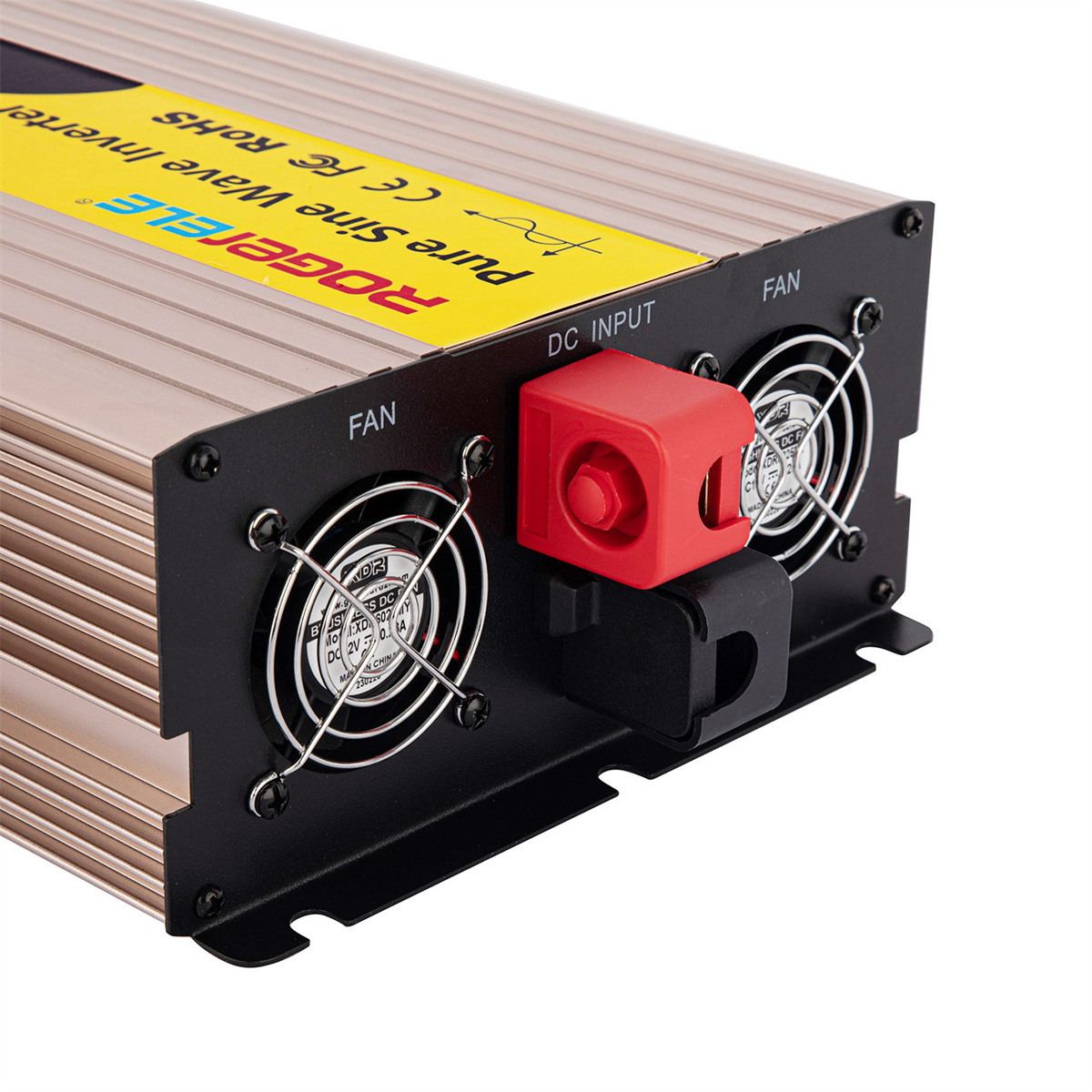 If you wash bikes, patio furniture or a single car with a compact 11A washer, the REP2000 pure sine wave inverter keeps the system smaller and lighter. It is rated 2000W continuous with a 4000W peak, up to 90% efficiency on the 12V REP2000-121 and no-load current under 0.9A. It measures 355 × 205 × 95 mm and weighs 3.9 kg. Run the washer alone, and avoid long thin extension cords, which add voltage drop and make the motor work harder at start-up.
Tip: test the restart, not just the first start
Run the washer, then release and squeeze the trigger ten times in a row. If the inverter beeps or the battery voltage drops near 10.5V during those restarts, the system needs a larger inverter, a stronger battery bank or heavier cables.
When to choose 3000W
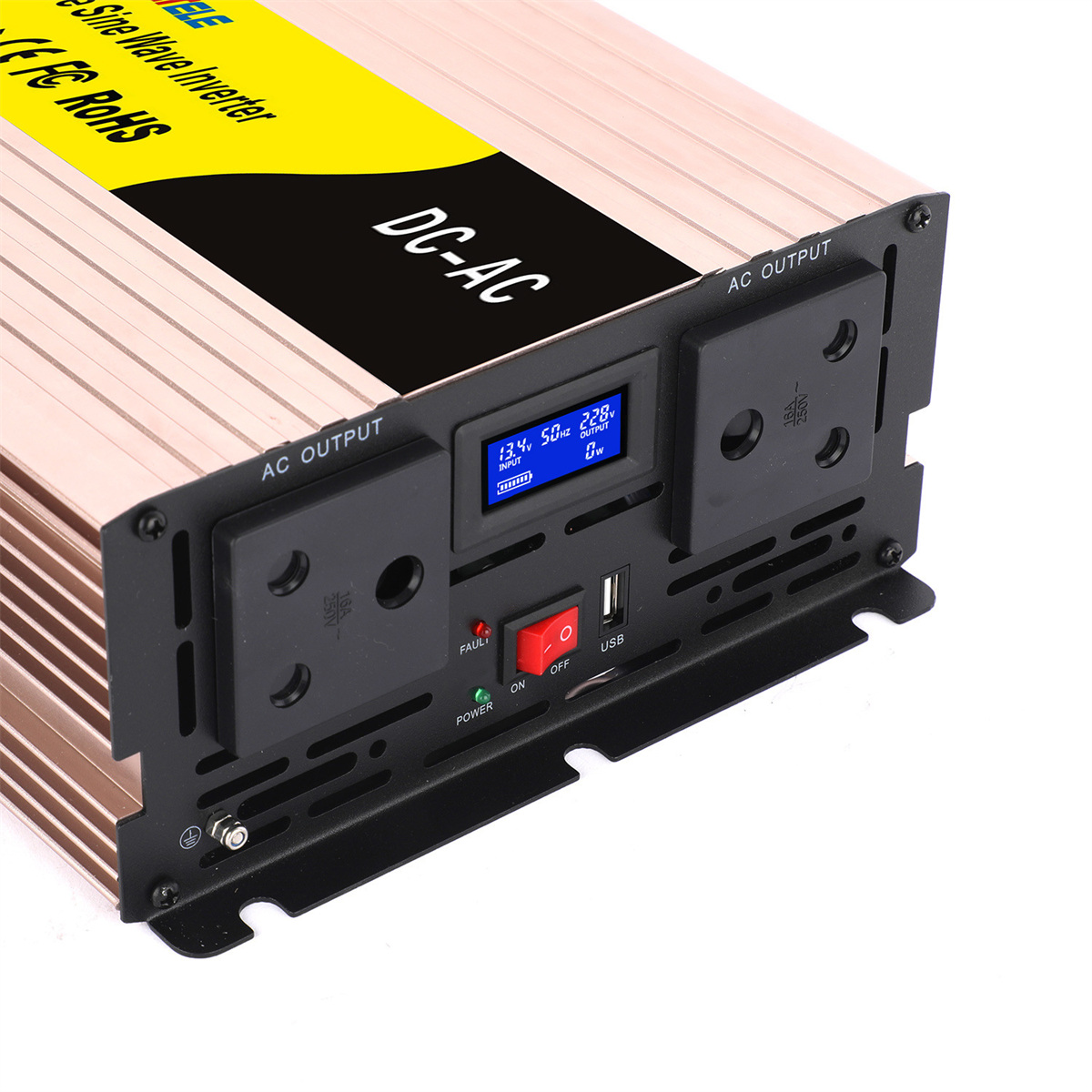 Choose the REP3000 pure sine wave inverter for 13 to 15A washers, daily commercial use, or when a shop vac, work lights or a battery charger share the same inverter. It is rated 3000W continuous with a 6000W peak, with listed maximum efficiency of 90% on 12V, 92% on 24V and 95% on 48V. The 12V REP3000-121 lists no-load current under 1A. It measures 415 × 205 × 95 mm and weighs 4.95 kg, small enough to mount on a van bulkhead near the batteries.
Consider 24V for a detailing van
A 1,560W washer draws about 145A at 12V but only about 72A at 24V. If you are building a dedicated mobile wash van, the REP3000-241 (24V, no-load under 0.7A) halves the current, allows thinner cables and reduces voltage sag during each motor restart.
REP2000-121 vs REP3000-121 specifications
| Specification | REP2000-121 | REP3000-121 |
|---|---|---|
| Rated / peak output | 2000W / 4000W | 3000W / 6000W |
| Waveform / THD | Pure sine, <3% linear load | Pure sine, <3% linear load |
| DC input / operating range | 12V / 10 to 15.5V | 12V / 10 to 15.5V |
| AC output (US version) | 100 / 110 / 120V ±5%, 60Hz available | 100 / 110 / 120V ±5%, 60Hz available |
| Max efficiency (12V) | 90% | 90% |
| No-load current | <0.9A | <1A |
| Low-voltage alarm / cutoff | 10.5V / 10V | 10.5V / 10V |
| Approx. battery current at full load | about 185A | about 278A |
| Size / net weight | 355 × 205 × 95 mm / 3.9 kg | 415 × 205 × 95 mm / 4.95 kg |
| Best pressure washer match | Compact 11A units, used alone | 13 to 15A units, plus small extra loads |
How much battery does a pressure washer need?
Washing time is what drains the battery. A 1,560W washer that runs about 60% of the time over a 45-minute car wash averages about 940W, or about 700Wh at the washer and about 780Wh from the battery, roughly 61Ah from a 12.8V LiFePO4 battery.
- Capacity: a 12V 200Ah LiFePO4 bank (about 2,560Wh) covers about three such washes before recharging; a detailing van doing six or more cars a day needs 400Ah or more, or charging between jobs.
- BMS current: the bank must deliver at least 170A continuous at 12V for a 13 to 15A washer, plus surge. A single 100Ah battery with a 100A BMS supports only about 1,100W of inverter load.
- Lead-acid: at 150A or more, AGM and flooded batteries sag quickly and the inverter can reach its 10.5V alarm long before the bank is empty.
- Charging: the REP series is an inverter only, with no built-in charger, so plan a DC-DC charger from the alternator, solar or shore charging to refill the bank.
Running drills, saws and compressors raises the same surge questions; see our guide on what size inverter you need for a coffee maker and job-site tools.
Wiring and safety tips
- Connect the inverter directly to the battery bank with short, heavy cables and a fuse on the positive cable close to the battery, sized for full-load current (about 185A for 2000W or 278A for 3000W at 12V) following the inverter manual.
- Mount the inverter inside the van, away from spray and standing water, with open space around both cooling fans.
- Plug the washer into a GFCI-protected outlet or an inline GFCI cord rated for 15A, since water and 120V are used together.
- Bond the inverter's ground terminal to the vehicle chassis as the manual describes.
FAQ
Can a 1500W inverter run a pressure washer?
Only a small 10 to 11A unit, and only with a good battery. Most 13A washers exceed 1500W running and surge well above a 3000W peak, so start at 2000W.
Should I run the engine while washing?
Idling helps the alternator replace some energy, but a stock alternator rarely supplies 150A at idle. Treat it as extra charging, not as the main power source.
Why does the inverter trip only when I pull the trigger?
That is the motor restart surge. Check cable size, battery BMS current and connections, or move to a 3000W inverter with a 6000W peak.
Conclusion
For a 13 to 15A electric pressure washer in a work van or pickup, choose a 3000W pure sine inverter so repeated motor restarts stay well inside its 6000W peak; a 2000W inverter is enough for compact 11A washers used alone. In both cases plan for 120 to 170A at 12V, a LiFePO4 bank whose BMS can deliver it, short fused cables and GFCI protection, or move to 24V for a dedicated wash van. Compare the full specifications of the REP2000 pure sine wave inverter and the REP3000 pure sine wave inverter, and for quotes, OEM options or custom DC input voltages, contact us: email Long@rogerele.com, Tel +86-577-62769701, WhatsApp +86-13587757588.
