
What Size Inverter for a Coffee Maker and Tools on a Job Site?
Date:2026-10-03 Click:179 Source:Rogerele
Quick answer: Size from the largest nameplate, and stay under the continuous rating. A coffee maker is a heater, so its watt label is the load for the whole brew. Under 900W, with no tool sharing the outlet, a REP1000 (1000W rated, 2000W peak) is enough. From about 900W to 1400W, use a REP1500 (1500W, 3000W peak). Tools add a motor start. Use a REP2000 (2000W, 4000W peak) when running watts stay under 2000W, and a REP3000 (3000W, 6000W peak) when a saw prints near 1500–1800W or start watts are missing. Match 120V 60Hz or 220–240V to the gear, and use 24V or 48V input at 2000W and above.
This is for a work truck, van or job-site battery, not a cable chart or a runtime sheet. Label figures are not Rogerele measurements.
Start with the coffee maker label
A drip or pod machine spends most of a cycle on a heating element. That is a resistive load, not a saw surge. Use the rating plate. If it shows amps, multiply by volts: 10A at 120V is 1200W, and 6.5A at 230V is about 1500W. Do not use a forum average. Small four-cup drippers are often under 1000W. Full-size machines often print 900W to 1500W for the heat cycle. If the plate is gone, do not guess down to 1000W.
Peak power on these pages is twice the continuous rating, and it is for a short surge. A heater can hold its label for several minutes, so leave room under rated watts. A 1400W brewer on a 1500W inverter is tight in a hot van. If the label is within about 10 percent of the rating, step up one model. A kettle is a second heater. Add both plates if they might run together.
Tools need running watts and start-up watts
Read a drill, a light or a charger the same way. The charger brick sets its watts. The product overview says this pure sine output suits sensitive electronics, naming an air conditioner and a refrigerator, and resistive loads, naming bulbs, a TV and fans. A coffee heater is the resistive case. A charger is the sensitive case.
A circular saw, grinder, reciprocating saw or small compressor is a motor. The plate is the running load. The first moment is higher, and many tools never print it. Overload turns the red LED on and shuts the inverter down. If start watts are unknown, do not set running watts equal to the inverter rating.
Under 1000W on the tool, and no brew at the same time, REP1500's 3000W peak is a fair margin. From 1200W to 1600W, use REP2000 (4000W peak). A 120V saw marked 13A to 15A is about 1560–1800W before it starts, so use REP3000 (6000W peak). That is label arithmetic, not a test of a saw brand.
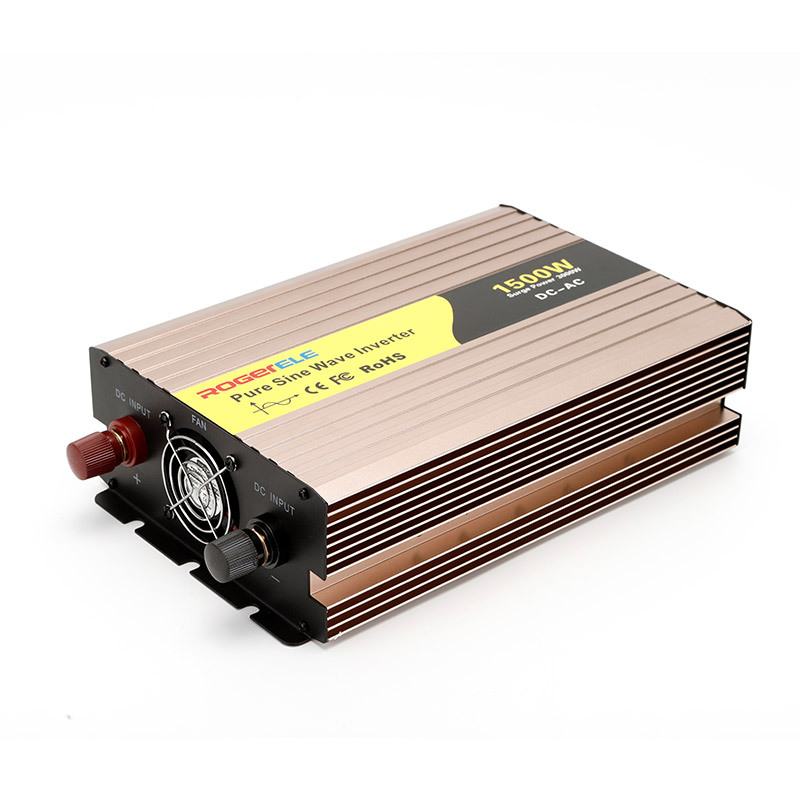
| Job-site case | What sets the size | REP model | Rated / peak | 12V no-load, less than |
|---|---|---|---|---|
| Coffee label under 900W, nothing else on | Heater watts for the whole brew | REP1000 | 1000W / 2000W | 0.4A |
| Coffee about 900–1400W, or a small tool alone | The larger nameplate, plus start margin | REP1500 | 1500W / 3000W | 0.8A |
| Running load under 2000W, start unknown | Continuous watts and a short motor peak | REP2000 | 2000W / 4000W | 0.9A |
| Saw near 1500–1800W, or coffee plus a tool | High running watts and an unprinted start | REP3000 | 3000W / 6000W | 1A |
No-load is the 12V "unload current less than" line. It is idle draw, not a saw-start figure.
Which REP pure sine model fits the truck
REP pure sine inverters run from 300W through 6000W. They convert 12V, 24V or 48V DC from dedicated batteries, or a DC outlet in a vehicle or boat, into 100V, 110V, 120V, 220V, 230V or 240V AC. Coffee and tools usually stop at REP3000. Above that, move up the series instead of stacking two small inverters.
THD is under 3 percent on a linear load. A heater is close to that test. A saw is not. Maximum efficiency is 90 percent on 12V. On 24V it is 91 percent for REP1000 and 92 percent for the larger three. On 48V those figures are 93 percent and 95 percent. Those are maximums.
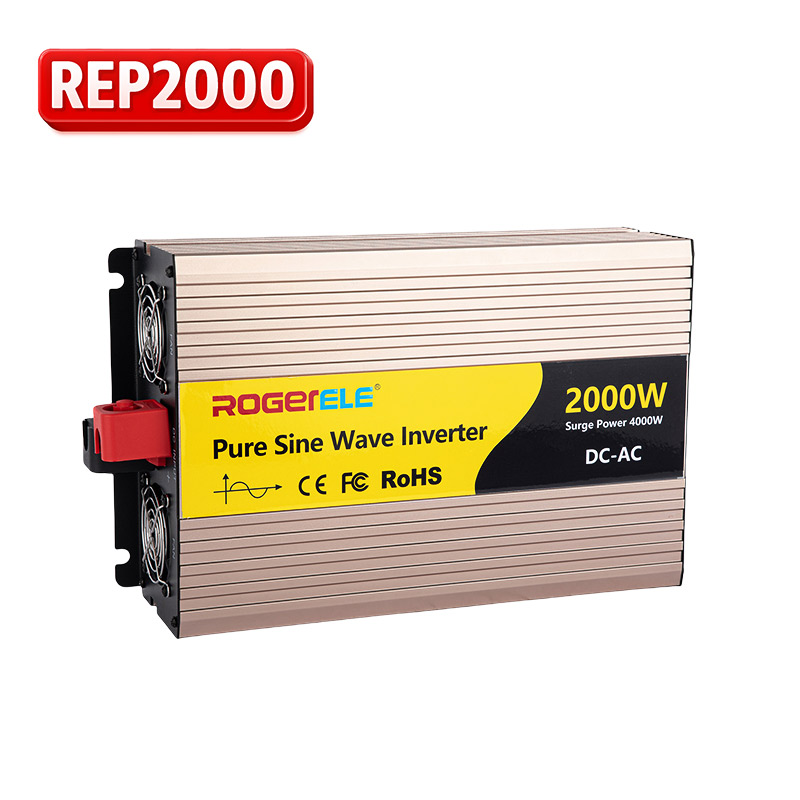
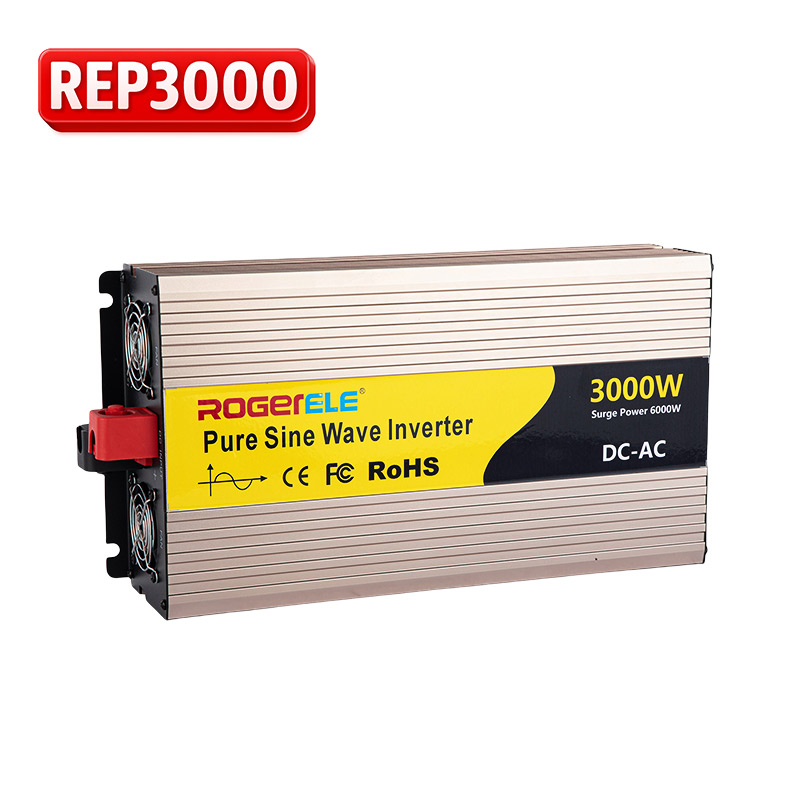
Net size: REP1000 is 275 × 180 × 80 mm and 2500 g, REP1500 is 310 × 180 × 80 mm and 2900 g, REP2000 is 355 × 205 × 95 mm and 3900 g, and REP3000 is 415 × 205 × 95 mm and 4950 g. Cooling is intelligent air cooling, with no noise figure published. Warranty is 2 years. Working temperature is −10° to +50°.
12V, 24V or 48V on a work truck
Match DC to the battery. The -121 models are 12V, -241 are 24V, and -481 are 48V, from REP1000 through REP3000. Input range is 10–15.5V, 20–31V or 40–61V. Custom inputs include 36V, 60V, 72V, 84V and 96V.
At the 90 percent 12V maximum, not a measured current, 1500W is about 140A, 2000W about 185A and 3000W about 280A. A 24V bank cuts that roughly in half. Keep coffee-only use on 12V. For tools, prefer REP2000-241, REP3000-241 or a 48V -481 model. On 12V the alarm is 10.5±0.5V and shutdown is 10±0.5V. Cable and fuse sizing is not covered here.
USB is QC3.0 on the 12V and 24V columns. The 48V columns show a slash, not QC3.0. It charges a phone, not a tool.
Order the voltage and frequency the tools expect
Names ending in 1, such as REP2000-241, are 100VAC, 110VAC or 120VAC ±5 percent. Names ending in 2, such as REP3000-242, are 220VAC, 230VAC or 240VAC ±5 percent. Frequency is 50Hz ±0.5Hz or 60Hz ±0.5Hz. A US job site wants 120V and 60Hz. Most 230V countries want 50Hz. Some regions use about 220V at 60Hz. Order the pair the tools were built for. A dual-voltage charger does not make a 120V saw safe on a 230V inverter.
Heat, overload, and what not to run together
Overload, over-voltage and short circuit shut the unit down with the red LED on. Low voltage and over-temperature alarm first, then shut down if they continue. The working ceiling is +50°, so keep vents clear in a hot cab. Do not hold peak watts for a long cut.
Do not brew and cut together unless both running labels sit under the rated watts and the start sits under the peak. A kettle plus a brewer fails the same way. If the red light comes on, drop the largest load.
FAQ
Will a 1000W pure sine inverter run a coffee maker?
Only if the label is under 1000W with margin and no tool shares the outlet. A 1400W or 1500W machine needs REP1500 or larger. Peak watts do not cover a heater that stays on for the brew.
What size inverter does a job-site circular saw need?
A 120V saw near 13A to 15A (about 1560W to 1800W running) belongs on REP3000, because the start is often unprinted. A saw under about 1600W can fit REP2000 if you are not brewing.
Can the coffee maker and a drill run together?
Add the two labels. If the sum nears the rating, run them separately. A small drill plus a modest brewer can share REP1500 or REP2000. A saw plus a brewer is one load at a time, or a REP3000.
Is 12V enough for tools in a work truck?
12V models exist through REP3000-121, but 2000W and 3000W pull very high current and shut down at 10±0.5V if the battery sags. Use 12V for coffee on REP1000 or REP1500. Use 24V or 48V for tools.
Why does the inverter shut off during a brew or a cut?
Overload, low voltage or over-temperature. Idle draw is not the cause. On 12V it is under 0.4A, 0.8A, 0.9A and 1A for REP1000, REP1500, REP2000 and REP3000.
