
Can I Connect a Power Inverter to My House Wiring for Backup Power?
Date:2026-10-07 Click:27 Source:Rogerele
Quick answer: Do not plug a power inverter into a wall outlet to power your house. That "backfeed" can send live voltage onto the utility lines, put 120V on the bare prongs of the cord, and destroy the inverter when grid power comes back. The safe ways are to run cords from the inverter's own outlets to the appliances, or to have a licensed electrician connect it through a transfer switch, an interlock kit, or a separate critical-loads panel. For a home backup that charges itself from the grid, look at an inverter with charger (UPS) running on a 24V or 48V battery bank.
A battery and a pure sine wave inverter can keep the fridge, lights and router running in an outage. This guide covers how to connect one to your home safely and how to size it.
Can I plug an inverter into a wall outlet to power my house?
No. A cord with a male plug on both ends is dangerous with any backup source. Three things can go wrong:
- Utility workers can be hurt. If the main breaker is on, the inverter output feeds back through your service transformer, which steps it up to high voltage on lines that crews think are dead.
- The cord's exposed prongs are live. Anyone who touches the free end while the other end is plugged in gets a shock.
- The inverter can be destroyed. When grid power returns, it meets the inverter output out of phase. An off-grid inverter is not built to synchronize with the grid.
In the USA, the National Electrical Code requires transfer equipment that stops a backup source from feeding the utility, and many local utilities and permit offices require the same.
What are the safe ways to use an inverter for home backup?
There are four common setups, depending on how many circuits you need and whether the change-over is manual or automatic.
| Setup | How it works | Electrician needed? | Best for |
|---|---|---|---|
| Cords from the inverter outlets | Plug loads straight into the inverter | No | Short outages, a few loads, renters |
| Manual transfer switch | Moves selected circuits to an inlet fed by the inverter | Yes, usually with a permit | Fridge, lights and outlets on a handful of circuits |
| Breaker interlock kit with inlet | Backup breaker can only be on when the main breaker is off | Yes, kit must be listed for your panel | Choosing circuits at the panel by hand |
| Inverter with charger feeding a critical-loads panel | Grid charges the battery; the inverter runs those circuits in an outage | Yes | Automatic backup for the most important circuits |
Not sure which inverter type fits? Compare UPS inverters vs hybrid inverters.
Which inverter is best for connecting to house circuits?
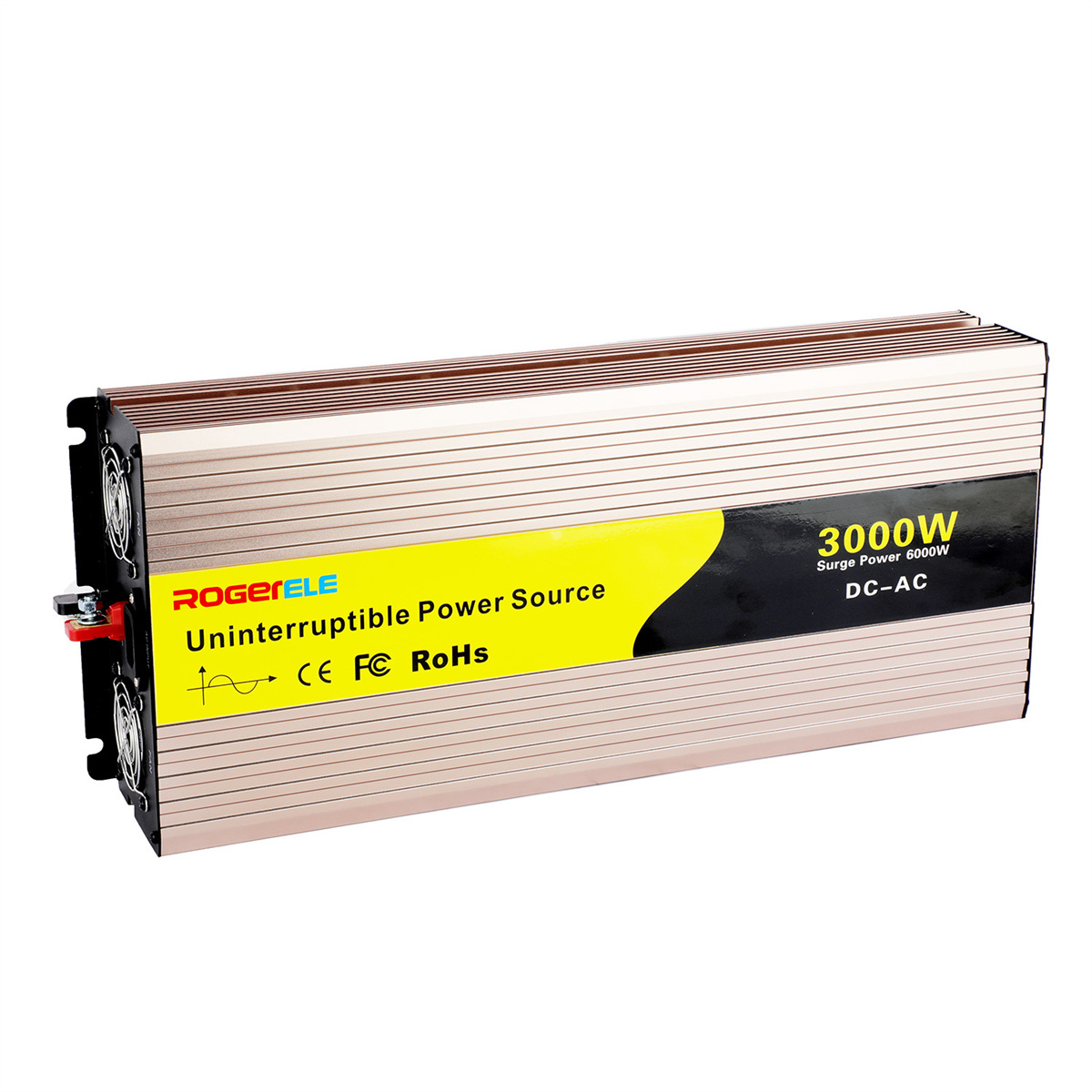
Choose a pure sine wave inverter, because fridges, furnace blowers and electronics are designed for a smooth sine wave. A plain inverter only turns battery power into AC. An inverter with charger (UPS) also recharges the battery from grid power, so it is ready for the next outage.
These are the published ratings for some Rogerele pure sine models that suit home backup:
| Model | Rated / peak power | Battery input | Built-in charger | Unload current (12V / 24V / 48V) |
|---|---|---|---|---|
| REPU-2000 | 2000W / 4000W | 12V, 24V or 48V DC | Yes, 30A / 20A / 10A | under 0.9A / 0.5A / 0.3A |
| REPU-3000 | 3000W / 6000W | 12V, 24V or 48V DC | Yes, 30A / 20A / 10A | under 1A / 0.7A / 0.4A |
| REP3000 | 3000W / 6000W | 12V, 24V or 48V DC | No | under 1A / 0.7A / 0.4A |
All three output 100, 110, 120, 220, 230 or 240V AC (±5%) at 50 or 60Hz, with THD under 3% on linear loads. For a home in the USA, order a 120V 60Hz version. The full range is listed under pure sine wave inverter with charger (UPS). Before an electrician wires any inverter into a panel, ask us for the wiring details for your model, including how the AC neutral and ground should be connected, and confirm how it switches between grid and battery.
Can a 120V inverter power my whole house?
Usually not. Most US homes have 120/240V split-phase service, and a single 120V inverter only supplies 120V circuits. A well pump, dryer, range, water heater or central AC stays off, and those loads draw more than a 2000W or 3000W inverter delivers anyway. Aim for a short list of critical circuits.
How to size it
- List the loads you want, such as a fridge, LED lights, router and TV.
- Add the running watts from each label. Add the starting surge of the largest motor; a fridge compressor often needs several times its running watts for a moment.
- Pick an inverter whose rated power covers the running total and whose peak power covers the surge. For many homes that means 2000W to 3000W.
Our home battery backup sizing guide has worked examples for 12V, 24V and 48V systems.
Should I use a 12V, 24V or 48V battery for home backup?
For 2000W and up, 24V or 48V is easier and safer to wire. Battery current is roughly watts divided by battery voltage and efficiency. At the REPU-2000's published maximum efficiency (90% at 12V, 95% at 48V), a 2000W load draws about 185A from a 12V bank but only about 44A from a 48V bank. Lower current means thinner cables and less voltage drop.
Battery size sets the runtime. A 5kWh bank running a 400W average load lasts roughly 10 to 11 hours before losses and depth-of-discharge limits; see how long a battery will run an inverter for the full formula, and LiFePO4 vs lead-acid to choose the chemistry. If you are building the bank from several batteries, read how to wire batteries in series or parallel.
What safety rules should I follow?
- Never backfeed through an outlet, and never bypass a transfer switch or interlock.
- Fuse the battery positive cable close to the battery and keep DC cables short.
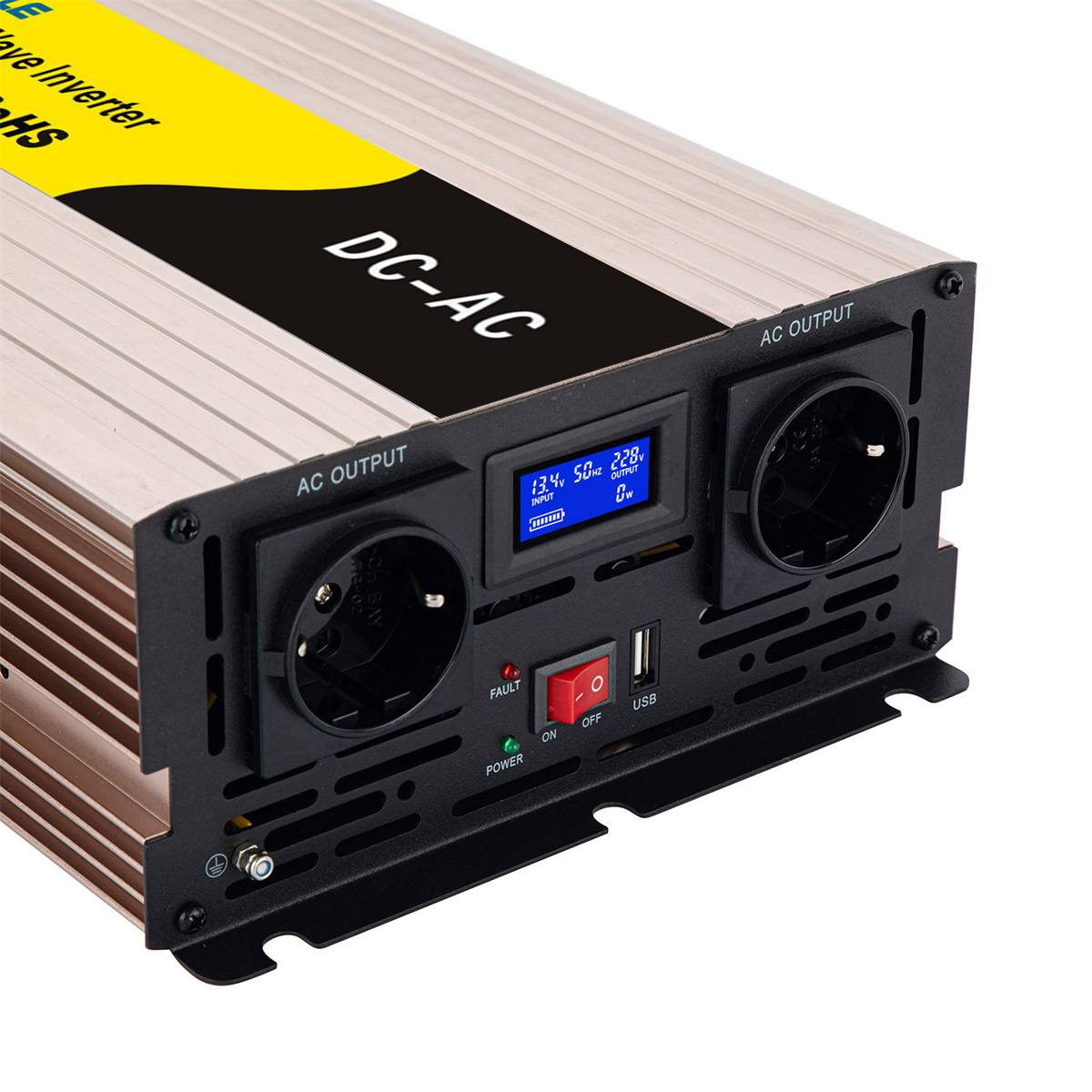
- Install the inverter in a dry, ventilated spot. REP and REPU units are rated for a working temperature of -10°C to +50°C and use fan cooling, so leave space around the vents.
- Follow local codes and use a licensed electrician for anything connected to the house panel.
FAQ
Is it illegal to backfeed a house with an inverter?
In most places it breaks electrical code and utility rules because it can energize the grid. Codes such as the US National Electrical Code require transfer equipment for backup sources. Check with your local permit office.
Can I run my fridge from an inverter with an extension cord?
Yes. This is the simplest safe setup. Use a heavy-duty cord rated for the load, and size the inverter for the compressor's starting surge.
Does an inverter with charger switch over automatically?
An inverter with charger (UPS) is designed to charge the battery from grid power and run the loads from the battery when the grid fails. Confirm the switching behavior for your model before connecting sensitive equipment.
Can I add solar panels to this backup system later?
Yes, with a separate solar charge controller that charges the same battery bank. Do not connect panels directly to the inverter's DC input. See how much solar you need to run a pure sine wave inverter.
What size inverter do I need for a fridge, lights and internet?
Many homes cover these with a 2000W pure sine inverter, and move up to 3000W if they add a microwave or coffee maker. Add up your own label watts and surge first.
Rogerele makes 12V, 24V and 48V pure sine wave inverters and inverters with charger. For a home backup model or an OEM version, contact our team.
