
E-Bike Charging Inverter: 300W vs 500W in a Car or RV
Date:2026-10-18 Click:5 Source:Rogerele
Quick answer: Most e-bike chargers draw 100–300W from the outlet, so a small pure sine wave inverter is enough to charge an e-bike in a car, truck or RV. A 300W pure sine inverter runs one standard 2A charger (about 100–130W) with room to spare. Choose 500W for a 4A–5A fast charger, for two bikes charging at once, or when the charger shares the inverter with a laptop. Plan on roughly 70–80Ah from a 12V battery to refill one 48V 14Ah e-bike pack from empty.
E-bikes now travel on hitch racks behind pickups, inside camper vans and on RV bike racks to trailheads and campgrounds with no hookups. The problem is simple: the battery runs low after a long ride, the only power source is the vehicle's 12V system, and the charger expects a 120V wall outlet. Pick an inverter that is too small and it trips when the charger starts; pick one that is far too large and it wastes battery at idle. This guide sizes the inverter with real numbers.
How much power does an e-bike charger use?
Most e-bike batteries are 36V or 48V nominal, which charge to about 42V and 54.6V. Common pack sizes run from about 400Wh to 750Wh; a 48V 14Ah pack, for example, stores about 670Wh. The charger's DC output tells you the load:
- A 36V 2A charger delivers about 84W, so it pulls roughly 100W from the outlet.
- A 48V 2A charger delivers about 110W and pulls roughly 130W.
- A 48V 4A fast charger delivers about 220W and pulls roughly 250–260W.
- A 48V 5A fast charger delivers about 270W and pulls roughly 320W.
These input figures assume the charger itself is about 85% efficient, which is typical for this kind of power supply. Check the label on your own charger: the output line (for example "54.6V 2A") is the most reliable number to start from.
Why a pure sine wave inverter for an e-bike charger
An e-bike charger is a switch-mode power supply designed for utility power. A pure sine wave inverter with THD below 3% gives it the same smooth waveform as a wall outlet. On a rough waveform, some chargers run hot, buzz, or refuse to start, and a charger that misbehaves is the last thing you want next to a lithium battery. For US vehicles, order the 100/110/120V, 60Hz output version so the charger sees the voltage it was built for.
When a 300W inverter is enough
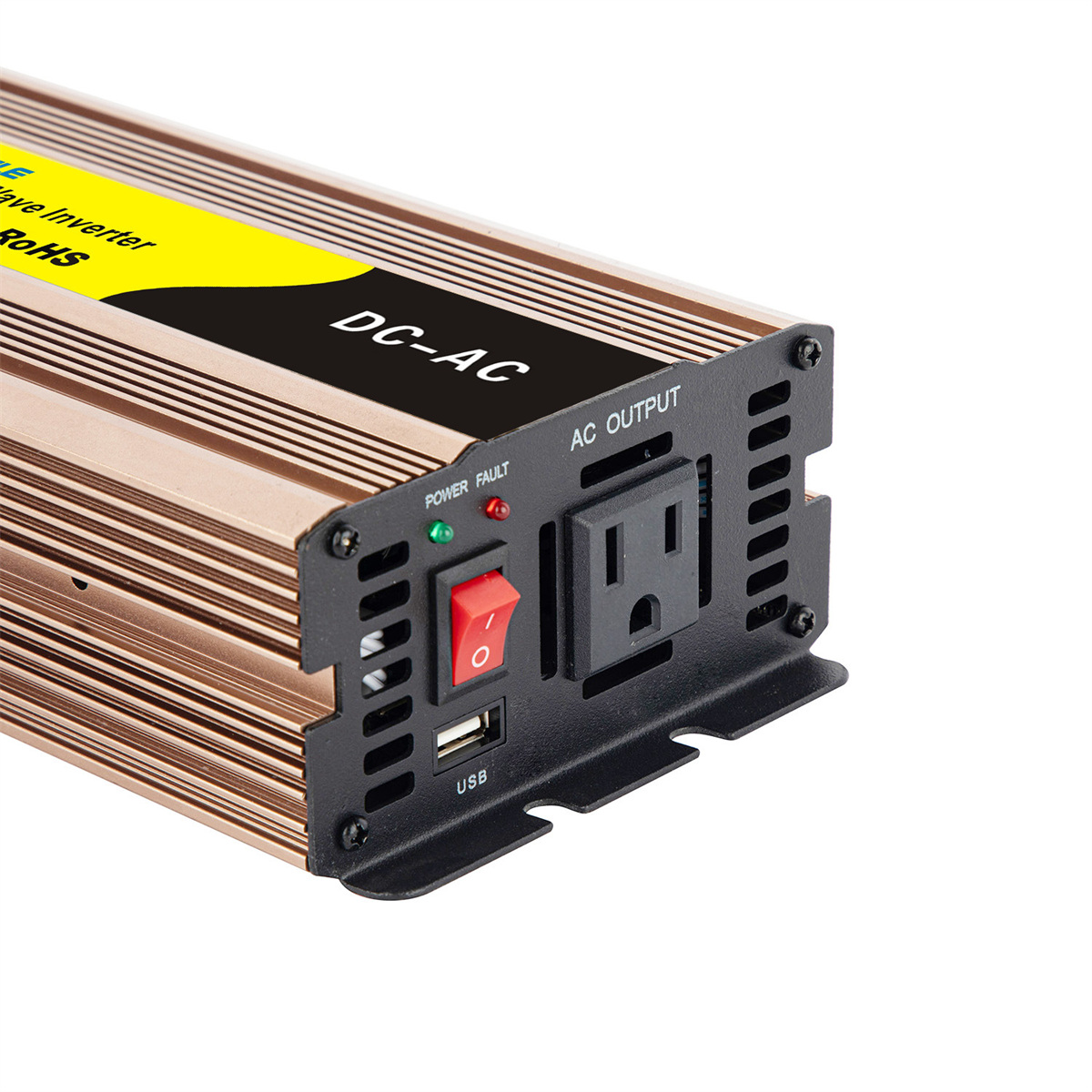 If you charge one bike at a time with the charger that came in the box, 300W is the efficient choice. A 48V 2A charger at about 130W uses less than half of the rating, which leaves margin for the short inrush when you plug the charger in and for a phone on the USB port.
The REP300 pure sine wave inverter lists 300W continuous and 600W peak, up to 90% efficiency, and a 5V / 1A USB port. The 12V model (REP300-121) draws under 0.3A with no load. It measures 208 × 112 × 60 mm and weighs 0.85 kg, small enough to mount under a seat or inside a truck toolbox.
Typical 300W setups
One commuter e-bike with a 36V 2A charger in a hatchback. One 48V mountain e-bike charging in a pickup while you eat lunch at the trailhead. One bike plus a phone in a small camper van. In each case the load stays under about 150W.
When to choose 500W
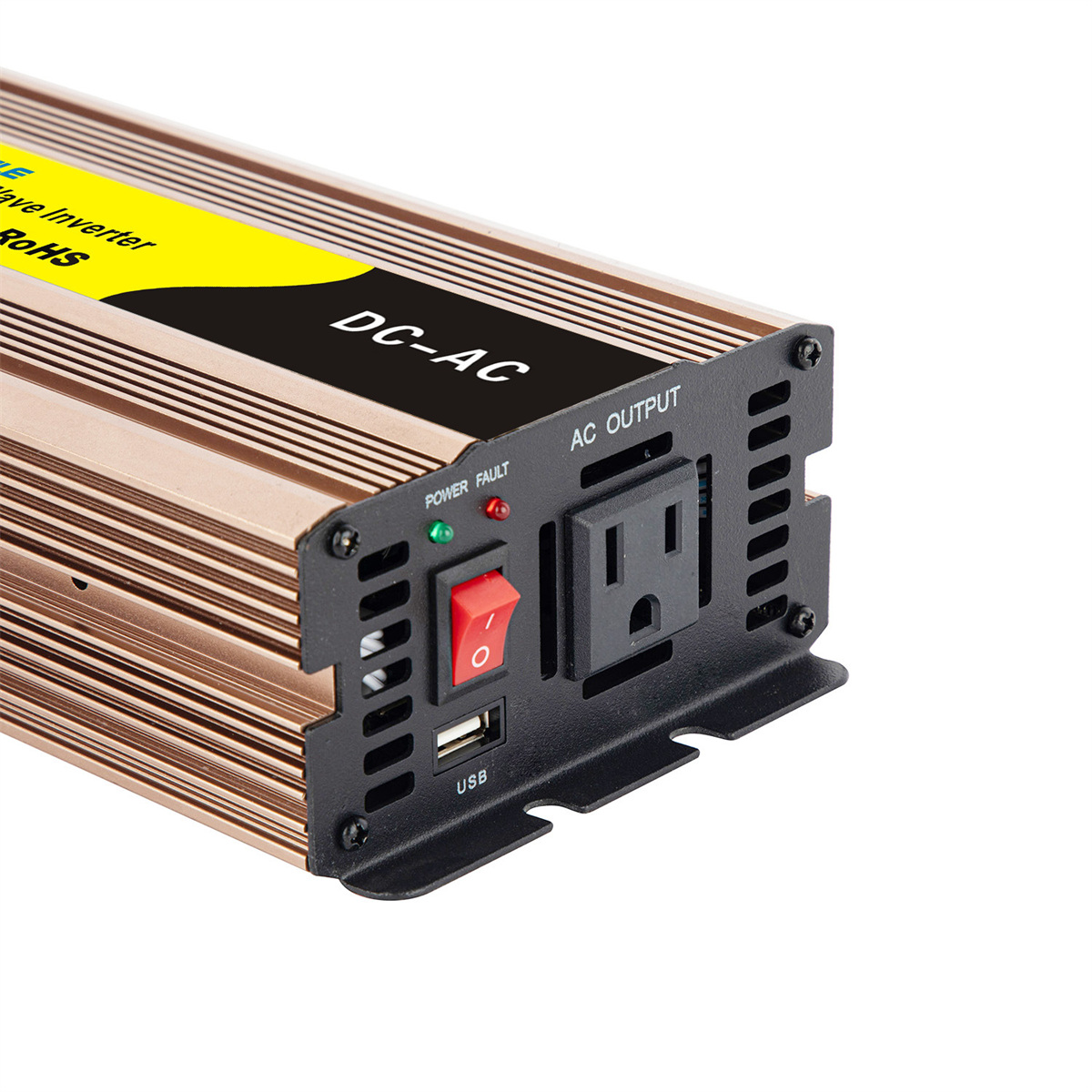 Pick 500W when the load goes past about 200W. A 4A fast charger at about 250W already uses most of a 300W inverter, and a 5A charger at about 320W is over it. Two 48V 2A chargers running together pull about 260W. Add a 65W laptop charger and you are near 330W. A 500W inverter keeps these loads at roughly 50–65% of its rating, so it runs cooler on a long charge.
The REP500 pure sine wave inverter lists 500W continuous and 1000W peak. Maximum efficiency is 90% for 12V, 92% for 24V and 95% for 48V models. The 12V model (REP500-121) draws under 0.4A with no load. It measures 255 × 112 × 60 mm and weighs 1.08 kg.
Load table: e-bike charging scenarios
| Charging scenario | Approx. AC watts | 12V DC current* | 300W? | 500W? |
|---|---|---|---|---|
| One 36V 2A charger | about 100W | about 9–10A | Yes | Yes |
| One 48V 2A charger | about 130W | about 12–13A | Yes | Yes |
| One 48V 4A fast charger | about 250–260W | about 24A | Tight | Yes |
| One 48V 5A fast charger | about 320W | about 30A | No | Yes |
| Two 48V 2A chargers | about 260W | about 24–25A | Tight | Yes |
| Two 2A chargers + laptop | about 330W | about 31A | No | Yes |
*DC current is estimated as AC watts ÷ (12V × 90% efficiency), plus the inverter's idle current. Charger watts are typical estimates; use the numbers on your own charger label.
REP300 vs REP500 specifications
| Specification | REP300 | REP500 |
|---|---|---|
| Rated / peak output | 300W / 600W | 500W / 1000W |
| Waveform | Pure sine, THD <3% (linear load) | Pure sine, THD <3% (linear load) |
| Maximum efficiency | 90% | 90% (12V) / 92% (24V) / 95% (48V) |
| No-load current, 12V model | <0.3A | <0.4A |
| DC input ranges | 10–15.5V / 20–31V / 40–61V | 10–15.5V / 20–31V / 40–61V |
| Low-voltage cutoff, 12V model | 10 ±0.5V | 10 ±0.5V |
| AC output options | 100/110/120V or 220/230/240V, 50 or 60Hz | 100/110/120V or 220/230/240V, 50 or 60Hz |
| USB port | 5V / 1A | 5V / 1A |
| Size / net weight | 208 × 112 × 60 mm / 0.85 kg | 255 × 112 × 60 mm / 1.08 kg |
How much 12V battery does a full charge take?
Work backward from the e-bike pack. A 48V 14Ah pack stores about 670Wh. With the charger at about 85% and the inverter at about 90%, a full charge from empty takes roughly 670 ÷ 0.85 ÷ 0.9 ≈ 880Wh from the vehicle battery. At 12V that is about 73Ah. A 500Wh pack needs about 650Wh, or about 54Ah.
A 12.8V 100Ah LiFePO4 house battery stores 1280Wh, and at 90% usable that is about 1150Wh: one full e-bike charge with some left over, but not two. A starting battery is a different story. Pulling 70Ah from a typical car starting battery with the engine off can leave it unable to crank, which is why the inverter's 10V low-voltage cutoff should be treated as a last line of defense, not a plan.
Charge while driving when you can
The easiest way to charge an e-bike from a car is with the engine running. A 2A charger adds only about 12–13A to the alternator load. Before running a fast charger on the road, read our guide on whether your car alternator can run a power inverter while driving.
Wiring and safety tips
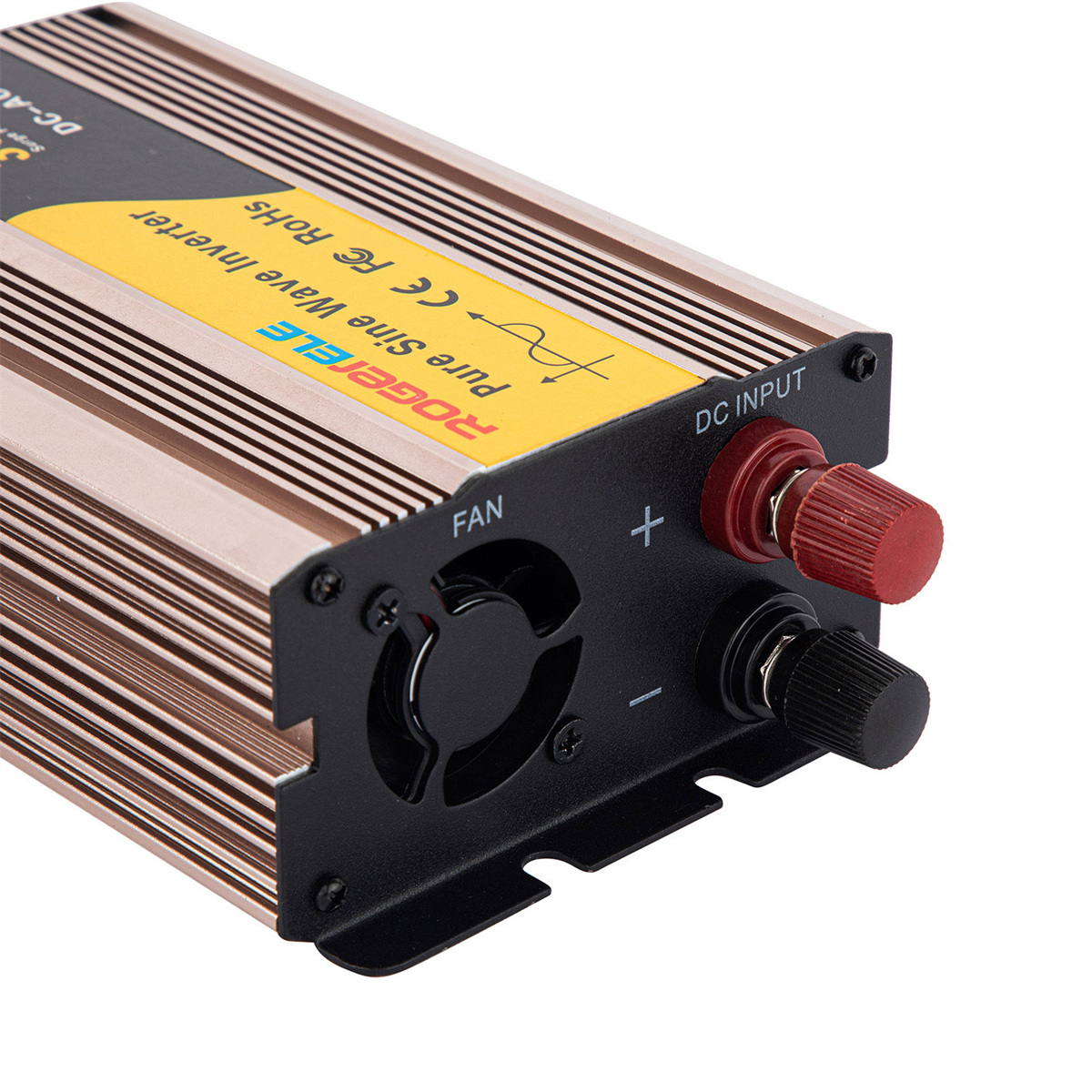
- A cigarette lighter socket is usually fused around 10–15A, which covers one 2A charger at best. For a fast charger or two bikes, hardwire the inverter to the battery with a fuse close to the battery.
- Keep the DC cables short. At 25–30A on 12V, a long thin cable drops voltage and can trigger the low-voltage alarm before the battery is actually low.
- Give the inverter room to breathe. The cooling fan needs open air, not a pile of jackets on top of it.
- Charge the e-bike battery where you can see it, on a hard, non-flammable surface, with its original charger. Do not leave it charging unattended in a closed trunk.
- Switch the inverter off when charging is done to save the idle current.
FAQ
Can I charge an e-bike from a cigarette lighter inverter?
Sometimes, with a 36V or 48V 2A charger, because the load is about 9–13A at 12V. Fast chargers need a hardwired inverter.
Is a bigger inverter better for a fast charger?
Size it to the charger, with about 30–40% headroom. A 500W unit suits a 4A or 5A charger; going much larger only adds idle draw, weight and cost.
12V or 24V?
Match the vehicle or house battery. Cars and pickups use 12V; many trucks and larger RV banks use 24V, and the 24V models draw half the current for the same watts.
Can I charge an e-bike in winter?
Most e-bike makers say not to charge lithium packs below freezing. Bring the battery into the warm cab or RV before you plug it in.
Conclusion
For e-bike charging in a car, truck or RV, a 300W pure sine inverter handles one bike on a standard 2A charger, and a 500W unit is the right size for fast chargers, two bikes, or a charger plus a laptop. Read your charger's output label, add everything that runs at the same time, and make sure the 12V battery can supply 55–75Ah per full charge. Compare the full specifications of the REP300 pure sine wave inverter and the REP500 pure sine wave inverter, and for quotes, OEM options or custom voltages, contact us: email Long@rogerele.com, Tel +86-577-62769701, WhatsApp +86-13587757588.
