
Pure Sine Wave Inverter PCBA Selection: From OEM Requirements to a Production-Ready Design
Date:2026-10-01 Click:161 Source:ROGERELE
Choosing an inverter PCBA is an integration decision. The board must work with the battery system, enclosure, cooling arrangement, controls and intended AC loads. A purchasing specification that lists only nominal power leaves too many questions unanswered.
For OEM equipment manufacturers and system integrators, the most useful starting point is a written description of the finished product. Establish its operating conditions first, then select and validate an inverter board against those conditions.
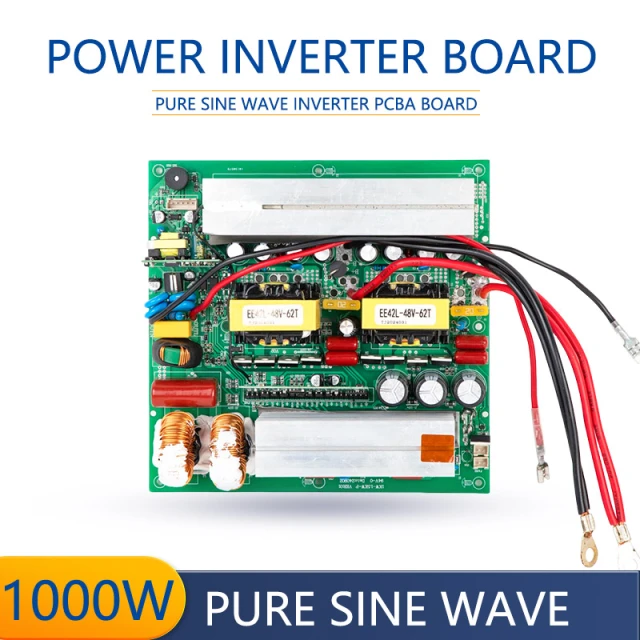
1. Define the finished product before selecting the board
Describe what the equipment must do in normal operation and during its most demanding operating cycle.
Your initial requirements should identify:
- The intended AC loads and which loads may operate together
- The expected continuous operating time
- Any motor, compressor or other load with demanding startup behavior
- The battery system’s nominal voltage and operating-voltage range
- The required AC output voltage and frequency
- The enclosure’s available space and installation orientation
- The expected ambient conditions and cooling arrangement
A nameplate wattage alone does not describe every load. Two appliances with similar running power may behave differently at startup. Share the actual load list and operating sequence with the board supplier, and agree how representative samples will be tested.
2. Treat battery compatibility as a system requirement
Selecting a nominal DC input voltage is only the first step. The board’s permitted input range must also be compatible with the battery system’s real operating conditions.
Ask the supplier to confirm the selected variant’s input limits, relevant protection behavior and recovery conditions. Separately check the battery, wiring, connectors, fuses and switching components against the complete system design.
Do not assume that a battery-management interface is included or that an inverter PCBA provides battery charging. If communication, charging or another additional function is required, list it explicitly and obtain written confirmation for the exact configuration being quoted.
3. Review the mechanical and thermal interfaces early
A board that fits inside an enclosure may still be unsuitable for the proposed installation. Mechanical review should cover more than its outside dimensions.
Request a controlled drawing showing mounting points, component-height limits, terminal positions and required clearances. Check how installers will reach the connections and whether the proposed harness routing interferes with airflow, service access or enclosure assembly.
Cooling should be assessed in the intended enclosure. Performance observed on an open bench does not establish performance inside the final product.
Agree a sample test that reflects the expected installation, load profile and ambient conditions. If a fan, heatsink or other cooling component is required, confirm what is included in the supply scope and what remains the OEM’s responsibility.
4. Separate standard configuration from customization requests
Clear customization requests help suppliers assess feasibility and avoid misunderstandings during quotation.
Organize the request into three groups:
- Mandatory requirements: functions or interfaces needed for the finished product to work
- Preferred options: features that improve usability or simplify assembly
- Future possibilities: items being considered for a later version
Potential discussion points include harness arrangements, control interfaces, mounting needs, labeling, packaging and documentation. These are topics for supplier review, not assumptions that every board supports every change.
For each agreed modification, define the responsible party, sample requirement, validation method and effect on lead time. Ask the quotation to distinguish the standard board from the customized configuration.
5. Validate samples with an agreed acceptance plan
A useful sample evaluation produces evidence that engineering and purchasing teams can both use.
The acceptance plan should identify the exact board revision, input source, test loads, enclosure configuration and measurement conditions. Include normal operation, representative startup events and operation under the intended thermal conditions.
Where protection behavior matters, agree safe test procedures with qualified personnel and record the observed response and recovery behavior. Do not rely on a generic feature list as a substitute for validating the selected configuration.
Keep a record of test results, approved deviations and any design changes requested before the next sample build. A sample approved without a clear configuration record is difficult to use as a reference for later deliveries.
6. Make the quotation specific enough for repeat orders
A procurement-ready quotation should identify exactly what will be supplied.
Ask for:
- Product model, selected variant and revision
- Agreed electrical specifications and operating conditions
- Included accessories, cooling components and harnesses
- Approved customization and associated documentation
- Sample and production quantities
- Packaging, labeling and traceability requirements
- Inspection criteria and acceptance documentation
- Lead time, commercial terms and warranty terms
If certification or compliance evidence is required for your market, request documentation for the exact product and scope. A claim associated with another model or a complete inverter should not automatically be applied to an individual PCBA or to your finished equipment.
Also clarify how component or design changes will be communicated after approval. This helps engineering teams decide when a change requires additional validation.
7. Use an application brief to start the supplier discussion
Possible integration projects include battery-powered equipment, mobile systems and other products that require DC-to-AC conversion. Suitability depends on the selected board and the finished system’s requirements; it should be established through engineering review and testing.
A concise application brief can make the first discussion more productive:
“Our product requires DC-to-AC conversion for the attached load list. The battery operating range, output requirements, enclosure drawing and duty cycle are included. Please recommend a suitable configuration, identify any integration constraints, and specify the samples and information needed for validation.”
This gives the supplier concrete information to evaluate and gives the buyer a clearer basis for comparing proposals.
Start with a defined integration requirement
The best inverter PCBA choice is the one that meets the finished product’s documented requirements and can be supplied consistently in the approved configuration.
Review ROGERELE’s pure sine wave inverter PCBA product information, then use your load list, battery requirements and enclosure plan to begin a focused technical discussion. Confirm the current specifications and available options before approving samples or placing a production order.
