
MPPT vs PWM Solar Charge Controller: Which Do You Need for Your Solar System?
Date:2026-09-27 Click:214
Quick answer: Choose a PWM solar charge controller only for small, low-cost arrays where the panel voltage is already close to the battery voltage. Choose an MPPT controller when you want more harvest from the same panels, when panel voltage is much higher than battery voltage, or when you are building a 24V/48V system. Size an MPPT with controller amps ≈ array watts ÷ battery volts × 1.25. If you also need AC backup or grid charging in one box, look at a solar hybrid inverter with built-in MPPT instead of a standalone controller.
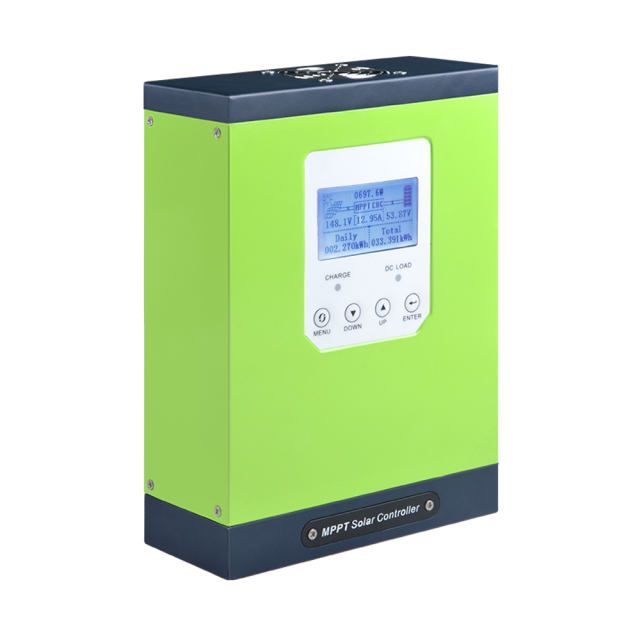
What is the difference between MPPT and PWM solar charge controllers?
Both controllers sit between your solar panels and your battery and keep charging within safe voltage limits. The difference is how they use the panel's power.
- PWM (Pulse Width Modulation) connects the panel to the battery and pulses that connection to hold the correct charge voltage. Extra panel voltage above the battery is not converted into extra current. PWM is simple and inexpensive when panel voltage is already close to battery voltage (for example a 12V nominal panel on a 12V battery).
- MPPT (Maximum Power Point Tracking) uses a DC-DC converter to track the panel's maximum power point and turn higher panel voltage into higher charging current. That usually means more energy from the same array, especially in cold weather or when panels are series-wired for a higher string voltage.
Rogerele's standalone controllers covered here are MPPT solar controllers. This comparison is about technology choice in the field; Rogerele's linked product page presents MPPT units, not PWM.
MPPT vs PWM: which should you buy?
| Question | PWM usually fits | MPPT usually fits |
|---|---|---|
| Array size | Small kits, often under about 200–400W | Larger arrays, or any system where harvest matters |
| Panel vs battery voltage | Panel Vmp close to battery voltage | Panel/string voltage much higher than battery |
| Battery bank | Simple 12V setups | 12V, 24V, 48V (and higher-voltage MPPT ranges) |
| Budget priority | Lowest controller cost | More energy per panel watt over the year |
| Wiring flexibility | Limited; panels often paralleled at low voltage | Series strings reduce DC current and cable size |
| Typical use | Small cabin light kit, boat trickle, entry RV | Home backup solar, off-grid cabin, workshop, larger RV |
If your panels already cost more than the controller, MPPT is usually the better buy because higher annual harvest often offsets the controller premium. For a tiny 100W panel on a 12V leisure battery where cost is the only concern, PWM can still be enough.
How do you size an MPPT solar charge controller?
Use this practical formula first:
Controller current (A) ≈ array watts ÷ battery volts × 1.25
The 1.25 factor leaves headroom for cold-weather voltage rise and manufacturer margins. Then check the controller's maximum PV input voltage and maximum PV input power against your string design.
Example: A 1200W array on a 24V battery bank needs about 1200 ÷ 24 × 1.25 ≈ 62.5A, so you would look at a 60A class unit and either trim the array slightly or step up to the next current rating / a higher battery voltage. On a 48V bank the same 1200W array needs only about 1200 ÷ 48 × 1.25 ≈ 31A.
Rogerele MPPT controller sizing examples
According to the Rogerele MPPT solar controller page, the 30IR–60IR models auto-detect 12/24/48V, while the 40A96–60A96 models cover 48/96V. Maximum PV input power examples from that page:
| Model | Rated current | Max PV @12V | Max PV @24V | Max PV @48V |
|---|---|---|---|---|
| 30IR | 30A | 420W | 840W | 1650W |
| 60IR | 60A | 900W | 1700W | 3400W |
The same page lists conversion rate >98%, tracking rate >99%, machine efficiency 96.50%, static power 2W, IP21, iron shell, Chinese/English LCD, three-stage charging, and optional lead-acid, colloidal, liquid or lithium batteries with customizable float/equalize voltages. Safety markings listed: CE, PSE, FCC and EMC. See also the solar charge controller category.
When should you use a standalone MPPT instead of a solar hybrid inverter?
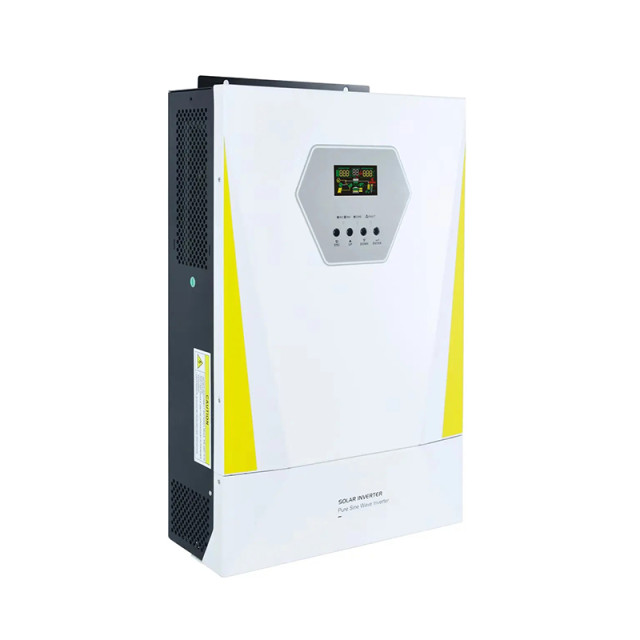
A standalone MPPT controller only manages solar → battery charging. You still need a separate inverter (or an inverter with charger / UPS) to make AC power. A solar hybrid inverter combines inverter + MPPT solar charger + AC charger in one enclosure.
- Choose a standalone MPPT when you already own a good inverter/UPS, when you want to expand solar without replacing the inverter, or when DC loads and charging control are your main need.
- Choose a hybrid inverter when you are building a new off-grid or backup system and want fewer boxes, shared monitoring, and both solar and grid/generator charging in one unit.
Rogerele hybrid options with built-in MPPT
- GA series high frequency inverter: GA3024JMH 3000W/24V, GA3524JMH 3500W/24V, GA5048JMH 5000W/48V, GA5548JMH 5500W/48V, pure sine wave. Built-in MPPT; PV max 4000W (24V models) or 5500W (48V models); MPPT range 120–430Vdc; max PV charge 60/80/100/100A by model; max AC charge 60/80/100/100A. Optional transfer 10ms (computers) or 20ms (home). Peak efficiency battery mode >94%. Certs listed: EN-IEC 60335-1, 60335-2-29, IEC 62109-1.
- RES-3K-65 / RES-6K-65: 3000W/24V and 6000W/48V. MPPT 50–450Vdc (RES-6K-65 has 2 trackers). Parallel up to 6 units (RES-6K-65). IP65. Efficiency up to 98% (marketing), DC-AC 93% off-grid, grid-tied max 97%. Wi-Fi. Max solar charge 100A / 135A.
If you are still sizing the inverter and battery bank for outages, see What Size Inverter Do I Need for Home Battery Backup?
Sourcing MPPT controllers and hybrid inverters from a factory
Wenzhou Rogerele Electronic Technology Co., Ltd. manufactures pure sine wave inverters, inverter-chargers (UPS), solar charge controllers and solar hybrid inverters in Yueqing, Wenzhou, China. Distributors and energy-storage brands can contact the Rogerele team for specifications, OEM/ODM options and quotes.
FAQ
Is MPPT always better than PWM?
Not always for tiny, low-budget kits where panel voltage already matches the battery. For most 24V/48V systems, series-wired arrays, or any setup where you care about kilowatt-hours harvested, MPPT is the better default.
Can I use an MPPT controller with lithium batteries?
Yes, if the controller supports a lithium profile or lets you customize charge voltages. The Rogerele MPPT controller page lists lithium as an optional battery type and notes that float/equalize voltages can be customized. Always match the settings to your battery datasheet.
What size MPPT do I need for a 1000W solar array?
On 12V: 1000 ÷ 12 × 1.25 ≈ 104A (often impractical; raise battery voltage). On 24V: ≈ 52A. On 48V: ≈ 26A. Then confirm the model's max PV watts and max PV input voltage for your string.
Do I still need a charge controller if I buy a hybrid inverter?
Usually no for the solar array connected to that hybrid unit, because the hybrid already includes MPPT charging. You may still add a separate MPPT if you expand solar onto a second array that the hybrid cannot accept.
PWM or MPPT for a camper / small cabin?
A single 100–200W panel on 12V can use PWM. Two or more panels, higher wattage, or plans to grow the system point to MPPT.
What else should I check besides amps?
Also check max PV input voltage and power, battery chemistry settings, enclosure rating (IP21 on the Rogerele MPPT controller vs IP65 on the RES hybrid), and whether you need Wi-Fi, parallel operation or AC passthrough.
